Get Full Government Meeting Transcripts, Videos, & Alerts Forever!
Get email alerts on the Charitable Gaming Permits topic
No spam. Unsubscribe anytime.
Committee votes ‘do not pass’ on bill to let service clubs get raffle permits before prizes are known
Summary
The Senate Judiciary Committee recommended a do-not-pass on Senate Bill 2189 after testimony that existing local permitting rules and prize-value limits already address the issue and that form or education changes could resolve the Exchange Club’s problem.
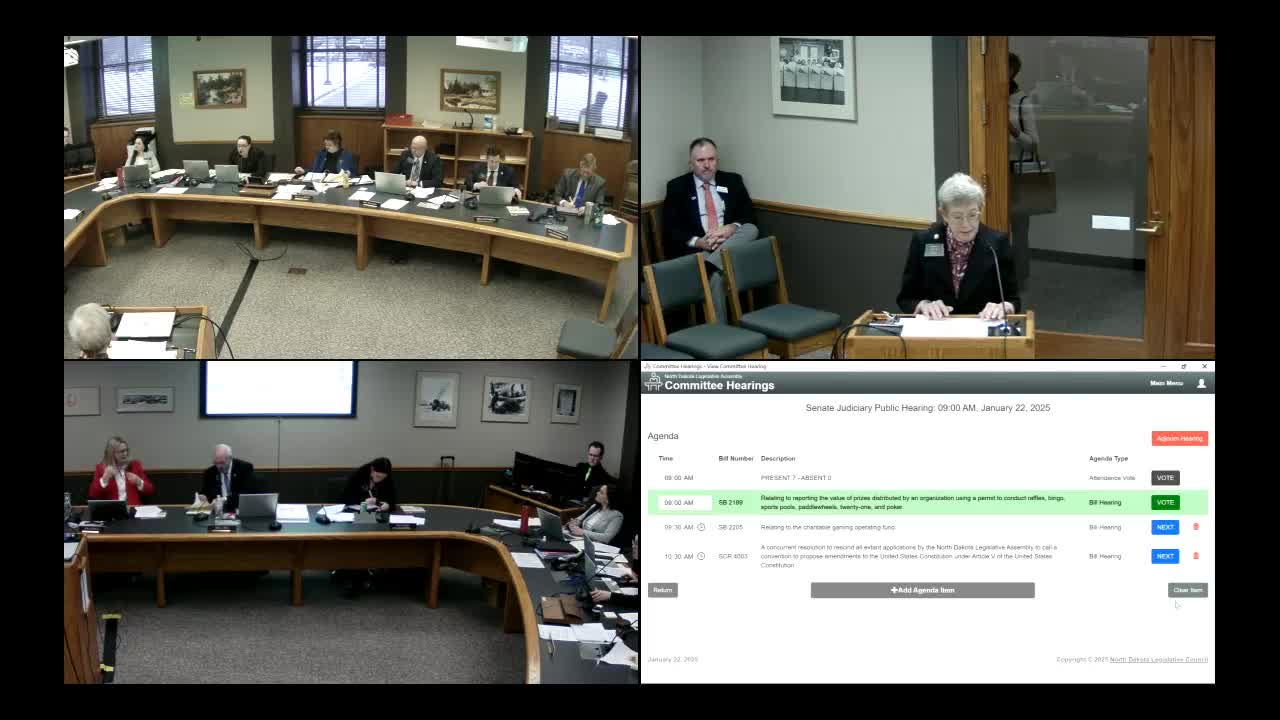
The Senate Judiciary Committee voted to recommend a do-not-pass on Senate Bill 2189, which would have allowed local governments to issue charitable-gaming permits before organizations finalized raffle or prize lists so permit numbers could be printed on event tickets.
Senator Judy Lee, sponsor of the bill, said the measure was prompted by a West Fargo Exchange Club that holds a meal-and-entertainment fundraiser. Lee said the club must sell event tickets weeks in advance but, after moving to the county fairgrounds, was told the county would not issue a permit until all prizes and their retail values were submitted. "They need to have the permit before they can order the tickets," Lee said. She asked for a statutory change to let local political subdivisions issue the permit for the event ticket in advance and allow the club to report prize values shortly after the event.
The bill’s chief neutral witness, Deb McDaniel, director of the Gaming Division in the Office of the Attorney General, told the committee the change is not necessary and could create administrative problems. McDaniel said current law requires local permits because prize limits determine whether a local permit suffices or if a state gaming license is required. "The primary prize cannot exceed $8,000 retail or cash, and the total of all prizes cannot exceed $40,000 in a year," McDaniel said. She said local governing bodies are intended to use permit applications to evaluate whether an organization qualifies and whether expected prizes fit within those statutory limits.
McDaniel suggested educating counties and cities or revising the application form to let applicants state expected prize types or offer an affidavit that prizes will not exceed statutory limits. She also warned that if permits were issued before prizes were known and the Attorney General’s office later received reports showing the legal limits were exceeded, the office would face additional enforcement work.
McDaniel also told the committee the House is considering House Bill 1192, which she said would raise the single-prize limit to $15,000 and the annual total to $50,000 if enacted.
After discussion, Senator Larry Lueck moved that the committee recommend a do-not-pass on Senate Bill 2189; the motion was seconded by Senator Bromberger. The roll-call recorded votes in favor from Senator Cory, Senator Bridal, Senator Castaneda, Senator Brownberger, Senator Lueck, Senator Paulson and Chair Larson. The motion carried.
The committee’s action means the committee will report the bill with a recommendation against passage; Lee presented the bill as a fix to a specific nonprofit fundraiser's operational problem, while the Attorney General’s office recommended administrative fixes to forms and local education instead of a statutory change.
No amendments were adopted during the hearing, and the committee did not set an alternate path for the sponsor within the hearing record.