Get Full Government Meeting Transcripts, Videos, & Alerts Forever!
Get email alerts on the Legacy Funds Overview topic
No spam. Unsubscribe anytime.
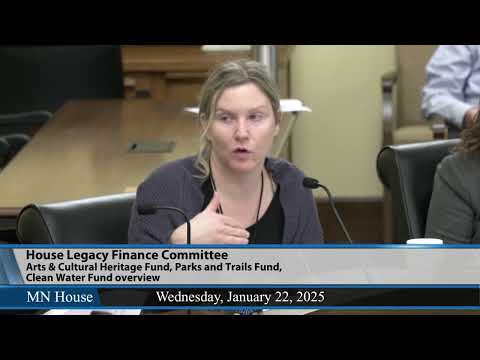
Legacy Finance Committee reviews fund rules, reserves and biennial totals
Summary
House Legacy Finance Committee staff reviewed the rules that govern Minnesota's four legacy funds, the constitutionally required reserve and projected biennial totals; staff outlined reporting requirements and how grants must supplement'existing funding.
The Minnesota House Legacy Finance Committee received an overview of how the state''legacy funds are governed, how much is likely available for the coming biennium and the reporting and reserve rules that will shape appropriations.
Mary Davis, a House Research analyst who staffs the Arts and Cultural Heritage portion of the committee, told members the Arts and Cultural Heritage Fund was created by a constitutional amendment approved by voters in 2008 and receives 19.75 percent of the 3/8 of 1 percent legacy sales tax. She said the amendment requires that legacy funds "supplement traditional sources of funding" and not be used to supplant them. "The Arts and Cultural Heritage Fund is a state fund that can be spent only for arts, arts education, and arts access and to preserve Minnesota's history and cultural heritage," Davis said.
The committee was also briefed on the Clean Water Fund and the Parks and Trails Fund. Janelle Taylor, House Research, said the Clean Water Fund receives 33 percent of legacy revenues and must be used "to protect, enhance, and restore water quality in lakes, rivers, and streams, and to protect groundwater from degradation," and that the constitution requires at least 5 percent of the Clean Water Fund be used to protect drinking-water sources. Taylor said the Clean Water Council, a body of citizen and agency representatives, makes recommendations to the governor and the legislature and that the council's recommendations have historically been followed in budgeting.
Brad Hagemeyer from the House Fiscal Analysis Department walked members through the committee's working numbers for the upcoming biennium, noting that a 5 percent reserve requirement across the legacy funds (a statutory reserve enacted in 2017) reduces the amount available for appropriation to prevent over-commitment if receipts fall. Using February forecast assumptions, Hagemeyer cited the approximate amounts available for the FY26-27 biennium after the 5 percent reserve: Outdoor Heritage Fund about $327.2 million (about $168.4 million annually), Arts and Cultural Heritage about $184.8 million, Clean Water about $310.8 million, and Parks and Trails about $133.1 million. He cautioned those figures will change with the February revenue forecast.
Committee members asked staff how the legacy funds interact with local projects and with specific contamination responses. Representative Tom DePel raised Hastings' PFAS contamination and asked whether Clean Water Fund money could be used there. Taylor said, "To the extent that the Hastings project protects drinking-water sources or otherwise meets that criteria, I believe the legislature could appropriate money for that purpose," and added that project sponsors can seek funding from the Clean Water Council or bring requests directly to the legislature.
The chair and staff also discussed reporting and transparency requirements. Davis noted recipients of Arts and Cultural Heritage money must report to the Legislative Coordinating Commission and to the committee with jurisdiction, providing accounting of distributed and unspent funds, summaries of funded programs and information on grants to individuals and organizations, and an assessment of whether grants reach diverse communities. She also referenced the state grants-management law (Chapter 16B) as governing grant agreements.
Members did not take formal action in the hearing; presenters provided guidance for the committee as it prepares appropriation language later in the session.