House panel refers bill to repeal retail delivery fee, alter transportation funding
Loading...
Summary
The Minnesota House Transportation Finance and Policy Committee unanimously referred House File 5 to the Tax Committee after a hearing where stakeholders urged repeal of the 50¢ retail delivery fee and debated reallocations and other tax changes affecting the Transportation Advancement Account and local road funding.
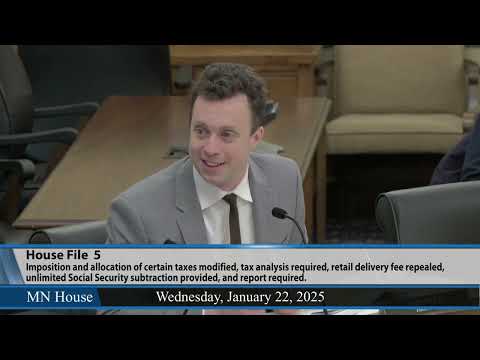
Representative Jim Joy introduced House File 5 on Jan. 22, 2025, telling the House Transportation Finance and Policy Committee the bill "is making Minnesota affordable" and that it would repeal the state's retail delivery fee, halt automatic motor-fuels indexing and pursue other tax changes tied to transportation funding.
The committee voted by voice to refer the bill to the House Taxes Committee. Representative Jim Joy made the motion to refer House File 5; the motion carried by voice vote and the chair announced, "The bill is referred to the committee on taxes." No roll-call tally was recorded in the hearing.
A central provision in the bill would repeal the 50¢ retail delivery fee enacted in 2023 and move some existing transportation taxes and allocations, including the motor vehicle rental tax, into the Transportation Advancement Account (TAA). Representative Joy said the bill also would pursue a "full elimination of Social Security tax" promised in campaigns and would end an automatic inflator on the gas tax so lawmakers, rather than an automatic formula, set future increases.
Nonpartisan fiscal staff and stakeholders described how the bill changes the flow of money to state and local transportation funds. "In your packets you should see two spreadsheet items," said the committee's fiscal analyst, Mr. Lee, who walked members through Department of Revenue and House Fiscal Office estimates. He said earlier projections for the delivery fee exceeded current receipts: "the estimate for fiscal year 2025 was that the delivery fee would bring in $59,000,000, and the current estimate is $35,000,000; for fiscal 2026 the estimate was $64,800,000 and the current estimate is $45,000,000; and for fiscal 2027 the estimate was $65,300,000 and the current estimate is $55,000,000." Lee also summarized proposed shifts in allocations to the Transportation Advancement Account and recipients such as trunk highways, county-state aid, municipal state aid, townships and metropolitan programs.
Business groups and local governments provided the bulk of public testimony. "We... express our strong support for the provisions in House File 5 that would repeal the highest consumer delivery fee in the nation," said Steve Barthel, director of government relations for the Minnesota Grocers Association. He told the committee updating point-of-sale systems and staff time make the fee costly for retailers and small businesses.
Trade groups offered similar testimony. "The three companies provided data showed 48,417 deliveries and they assessed 2,336 delivery fees," said Dave Wagner, executive director of the Minnesota Propane Association, summarizing member data and adding that the three companies remitted a combined $1,168 to the state in the period he cited. Wagner said one company reported $25,100 in labor costs for implementing the fee.
Local-government groups urged caution about how revenue streams are changed. "We oppose repealing indexing that was enacted less than two years ago," Anne Finn of the League of Minnesota Cities told the committee, saying cities rely on predictable, ongoing funding for a system of city streets, particularly for smaller municipalities. Cap O'Rourke of the Minnesota Association of Small Cities and Mike Lund of Metro Cities similarly said their members need stable, predictable funding and asked the committee to preserve or replace revenues so small cities and metropolitan jurisdictions are not harmed.
Townships also emphasized dependence on state revenues. "Townships spend about $230,000,000 per year on their township roads — that's 55,000 miles of road," Steve Penske of the Minnesota Association of Townships told the committee, noting townships have limited local revenue sources and need reliable state support.
Experts offered broader critiques of the delivery fee as a funding tool. John Phelan, an economist at the Center of the American Experiment, said the fee contains many exemptions that complicate compliance, tends to be regressive for users of delivery services, and interacts awkwardly with evolving vehicle fuel economy and electric-vehicle trends. Retail and small-business witnesses warned of compliance costs, card-processing fees that reduce the remitted amount, and competitive disadvantages to local retailers.
Committee members asked questions about who pays the delivery fee, how exemptions work and why receipts have fallen short of original forecasts. Department staff explained the fee is imposed on sellers in many cases but contains exemptions (for example, some food, medical and baby products and a $100 transaction threshold) that reduce collections and complicate administration. Several members said the fee underperformed projections and that consumer behavior — splitting purchases to avoid the threshold — appears to reduce expected revenue.
Representative Joy and several committee members framed the bill as an attempt to reduce costs for Minnesota households and small businesses while preserving or reallocating funding to local governments. The committee took no final action on the underlying policy in the hearing beyond referring House File 5 to the House Taxes Committee for further consideration.
Votes at a glance: Representative Jim Joy moved that House File 5 be referred to the committee on taxes; the motion carried by voice vote and the chair announced the referral. The record does not show a roll-call tally.