Get Full Government Meeting Transcripts, Videos, & Alerts Forever!
Get email alerts on the Judiciary Budget topic
No spam. Unsubscribe anytime.
Judicial branch asks for 12% budget increase, cites staffing, accessibility and service-cost pressures
Summary
State court administration briefed the Senate Judiciary and Public Safety Committee on budget requests for FY2026–27, seeking a roughly 12% increase to address compensation, digital accessibility, rising interpreter and psychological examiner costs, and jury pay.
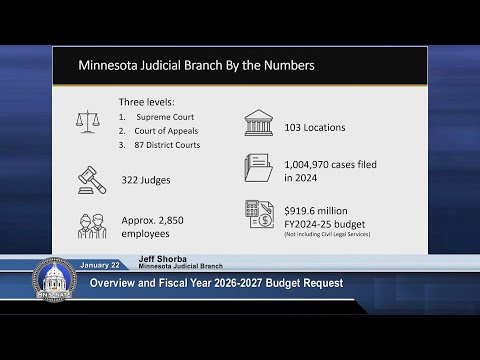
Jeff Schorba, State Court Administrator, told the Senate Judiciary and Public Safety Committee on Jan. 22 that the Judicial Branch seeks support for its FY2026–27 biennial budget request, describing an approximately 12% increase to the branch’s base budget to meet operational and statutory obligations.
The request, Schorba said, is driven by personnel and mandated service costs. "Justice delayed is justice denied," he said, arguing the branch must maintain competitive pay to retain and recruit judges and roughly 2,800 court staff who process about 1,000,000 filings a year. He described the FY2025 appropriation level as about $479,000,000 and said last session the branch received roughly $86,000,000 in ongoing funding and about $52,000,000 in one-time funding.
Scholarly and practical pressures cited in the presentation included a 15% increase in employee turnover since 2020, a 27% fall in applicants per posted position, a 143% increase in psychological evaluations since 2020, and rapidly rising interpreter needs. Schorba said interpreter events have nearly doubled since 2019 and now encompass services in roughly 134 languages. He told the committee the branch is requesting a set of targeted investments: a 6% employee compensation pool, a market-based raise for psychological examiners from $136 to $175 per hour, a proposal to increase juror pay from $20 to $100 per day to broaden jury pools, $5.1 million (one-time) for digital accessibility work to meet new federal requirements under the Americans with Disabilities Act rule effective April 24, 2026, and approximately $4.0 million (one-time) to modernize partner access to court records.
Schorba told senators the branch is funded primarily through legislative appropriation and does not retain fines or fees. He described recent administrative changes including a new remote‑hearing framework to take effect Feb. 3 and several technology upgrades (a digital exhibit system, e check‑in and an online scheduling tool for incarcerated individuals).
Committee members asked about compensation mechanics, vacancies and technical projects. Schorba described the branch’s merit-based compensation pool for nonjudicial staff and said unfilled positions are "very, very low" while acknowledging recruiting challenges in some districts. On digital accessibility, he said the branch is coordinating with executive-branch work already funded by the state and that spreading large projects over more years would lengthen timelines.
The hearing was informational; no appropriation votes were taken. Committee members repeatedly noted the branch represents a small share of the general fund (Schorba put it at roughly 1.5%), while performing constitutionally mandated functions.
Ending note: Committee members said they will continue discussions with the executive branch and legislative leadership as budget negotiations proceed in coming months.