Get Full Government Meeting Transcripts, Videos, & Alerts Forever!
Get email alerts on the Hospital Finance topic
No spam. Unsubscribe anytime.
Minnesota hospitals warn of statewide access risk, urge legislature to adopt directed payments and protect 340B
Summary
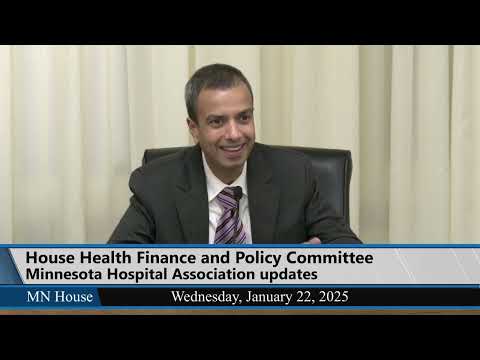
Hospital leaders from across Minnesota told the House Health Finance and Policy Committee on Jan. 22 that hospitals are financially strained and urged lawmakers to adopt a directed payments program to increase Medicaid reimbursements, protect the federal 340B drug discount program and fund workforce and discharge solutions.
Hospital leaders from across Minnesota told the House Health Finance and Policy Committee on Jan. 22 that hospitals are financially strained and urged lawmakers to adopt a directed payments program to increase Medicaid reimbursements, protect the federal 340B drug discount program and fund workforce and discharge solutions.
The hospitals’ case centered on persistent underpayments from government programs, rising labor and supply costs since 2019, and growing patient “boarding” — patients held in emergency departments or hospital beds because appropriate post-acute or mental-health placements are unavailable. The Minnesota Hospital Association and leaders from Winona Health, Riverview Health (Crookston), Aspirus Lakeview (Two Harbors), Community Memorial (Cloquet) and Rainy Lake Medical Center (International Falls) testified and urged prompt legislative action.
"We are the ultimate safety net, the provider of last resort, and this safety net is fraying," said Rahul Ghoraneh, president and CEO of the Minnesota Hospital Association. He and other witnesses described a statewide pattern of hospitals operating at or below cost, with many losing money in recent years.
Leaders gave local examples to illustrate the statewide problem. Rochelle Schulz, CEO of Winona Health, said her hospital is a 49-bed prospective payment system facility with a payer mix that is increasingly government-funded and that it experienced its worst year in 2023, "losing $17,000,000," and reduced that loss to $12,000,000 in 2024. Schulz said Winona’s dialysis program was losing about $1,000,000 a year until a local donor provided $3,000,000 to preserve the service for roughly three years. She also stressed Winona’s reliance on the 340B program and quoted a Department of Human Services estimate that the Medicaid fee-for-service inpatient payment covered about "68¢ on the dollar" based on 2019 cost data.
Carrie McCulsky, president and CEO of Riverview Health in Crookston, described a string of financial losses since the hospital opened a new facility in 2020. She said Riverview borrowed $54,000,000 for the project, has lost $5,000,000 to $6,000,000 annually in recent years, and reported 52 days cash on hand at the end of December — below the 75-day reserve it promised to bondholders. McCulsky said Riverview was forced to close its nursing home and now uses swing beds and other stopgaps while community nursing-home capacity declines.
Greg Ruberg, president of Aspirus Lakeview Hospital in Two Harbors, emphasized transfer and discharge challenges that affect both rural critical-access hospitals and larger tertiary centers. He said hospitals routinely contact facilities across multiple states seeking a higher level of care, and sometimes must transfer patients long distances because local or regional beds are not available. Ruberg described instances in which local EMS availability also constrained transfers.
Rick Brewer, CEO of Community Memorial Hospital in Cloquet, and Kelly Hagan, chief nursing officer at Rainy Lake Medical Center in International Falls, stressed workforce and service-line risks. Brewer described the threat to rural obstetrics and a simulation training program his hospital hosts; Hagan described persistent vacancy pressures and said many nurses now opt for part-time schedules.
Joe Schindler, vice president for finance and policy at the Minnesota Hospital Association, presented a policy proposal the association will ask lawmakers to consider: a statewide directed payments program (DPP). He described the mechanics: hospitals would contribute a state-share assessment that the Department of Human Services would use to draw federal matching dollars and return as supplemental Medicaid payments. Schindler said the program is federally approved in other states and repeatedly stated it could be structured with "no general fund spending." He and other witnesses estimated an assessment in the model discussed would total roughly $800,000,000 in state-share hospital contributions and draw about $1,000,000,000 in federal matching funds, though modeling showed results vary by facility.
Mary Krenke of the Minnesota Hospital Association summarized financial aggregates: uncompensated care, Medicaid underpayments and Medicare underpayments have each exceeded $1,000,000,000 in recent reporting, and hospitals reported roughly $6,200,000,000 in community benefits statewide. Witnesses repeatedly urged lawmakers to avoid new mandates that would raise hospital costs without direct reimbursement and to protect the 340B program, which small hospitals said helps keep specialty outpatient drug prices manageable.
No formal committee action or vote occurred during the hearing. Schindler said the association expects to forward legislation proposing a directed payments mechanism within days.
Committee chair Backer closed the hearing and noted the committee’s next meeting date on Jan. 27; hospital witnesses said they would continue to engage with legislators during the session.