Get Full Government Meeting Transcripts, Videos, & Alerts Forever!
Get email alerts on the Education Cde Tuition topic
No spam. Unsubscribe anytime.
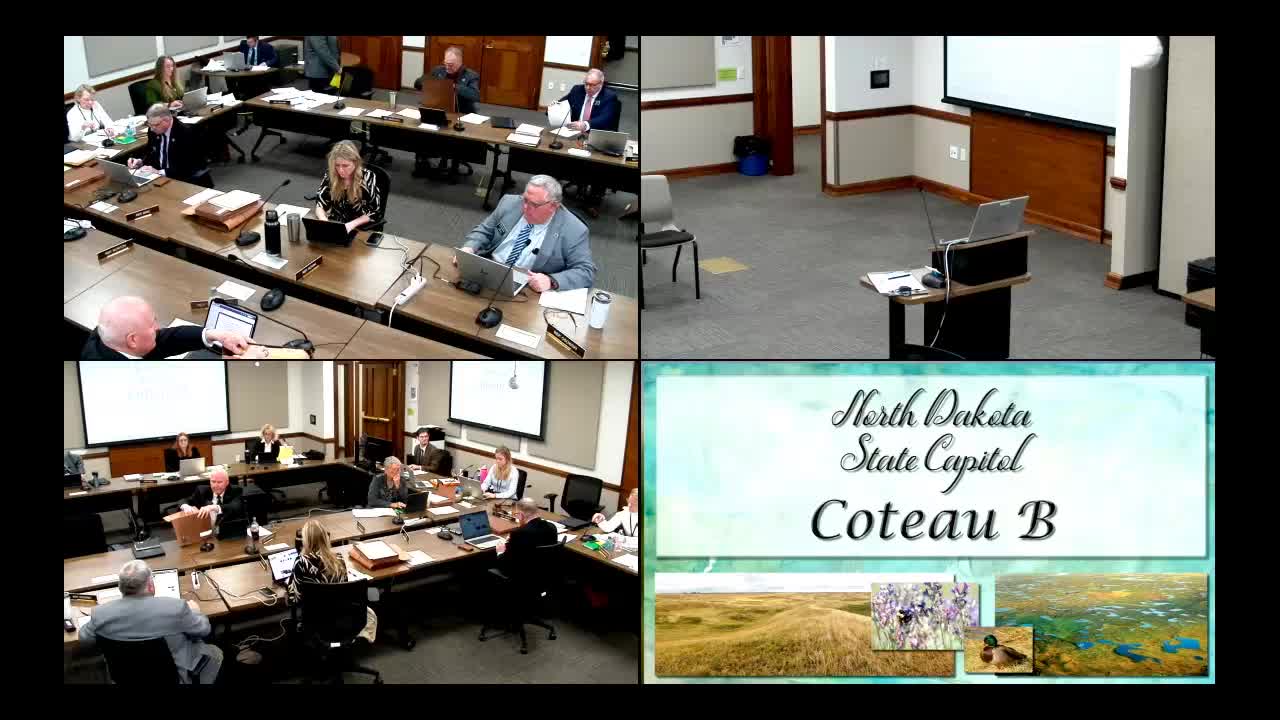
House panel weighs shifting CDE tuition costs as districts, state agency clash
Summary
Lawmakers, district leaders and the North Dakota Center for Distance Education debated House Bill 1172 before the House Education Committee, with sponsors proposing parents pay in limited cases and the state virtual school warning the change would shrink its revenue and force cuts.
The House Education Committee heard competing accounts on House Bill 1172, which would change when parents rather than school districts must pay tuition for courses through the North Dakota Center For Distance Education (CDE).
Representative Pat Heinert, sponsor of HB1172, told the committee the bill “meets in the middle” by making parents responsible for CDE tuition only when the home district both offers the course and can reasonably accommodate the student’s schedule. "The bill says that a parent is responsible for the CDE course only if only if the school offers it and can make accommodations for the student," Heinert said during the hearing.
Supporters said the change would curb what they called duplication of services and reduce unplanned costs for districts. Bismarck Public Schools Superintendent Dr. Jeff Fosnott told the panel that recent state policies shifted the tuition burden onto districts and produced a large, unanticipated local cost. "The unintended consequence of the virtual learning bill last session was the cost to residents of Bismarck Public Schools," Fosnott said, correcting an earlier figure and saying the district had distributed about $98,000 in CDE tuition through Nov. 30 this school year. He urged that HB1172 would better protect local taxpayer dollars.
Administrators from large high schools described operational impacts. Century High School principal Steve Madler said last school year his building recorded 459 CDE enrollments; only a small share (19 enrollments, 4 percent) were for classes the school did not offer, while 30 enrollments (about 6.5 percent) reflected scheduling conflicts. Madler said duplicate enrollments and late withdrawals created both visible tuition costs ($104,636 for his building) and hidden staffing costs because sections could not be reduced after contracts were set. He also cited a spike in students needing credit recovery after failing CDE courses and reported a roughly 18 percent failure rate for ND CDE enrollments and 21 percent failure rate at his building for 2023–24.
The state director for the North Dakota Center For Distance Education, Alyssa Martin, opposed the bill. Martin said the agency has expanded quickly during the current biennium and that shifting tuition back to parents would shrink NDCDE revenue and force program and staff reductions. "This reduction would force us to cut staff and course offerings," Martin told the committee, adding that NDCDE had provided about 28,000 course enrollments during the biennium and employed more than 100 people across full‑time, temporary and adjunct positions.
Alyssa Martin and assistant principal Emily Schaeffer described student reasons for choosing CDE beyond scheduling, including medical needs, severe anxiety, mobility, and safety concerns. Schaeffer said CDE had allowed students with medical restrictions and serious anxiety to remain in school and keep up with coursework when in‑building alternatives were not feasible.
Members of the panel and witnesses discussed possible changes to the bill's language and local appeals processes. Several superintendents and principals said they already use locally defined committees or deposit-based practices to manage online enrollments and would support written provisions that require a conversation between parents and the district before shifting tuition. Madler urged careful drafting around the bill’s phrase "preferred class schedule," warning the term could be used to create loopholes.
No committee vote was recorded during the hearing. The committee concluded the public testimony and indicated it would continue deliberations at a later time.