Get Full Government Meeting Transcripts, Videos, & Alerts Forever!
Get email alerts on the Childcare topic
No spam. Unsubscribe anytime.
Minn. House panel hears that family child care providers are leaving amid licensing, funding problems
Summary
The Minnesota House Children and Families Committee heard testimony that family child care providers are leaving the field and that state licensing and funding practices are worsening a statewide shortage.
The Minnesota House Children and Families Committee heard extended testimony about a statewide shortage of family child care and what providers called burdensome licensing and funding practices that are driving programs to close.
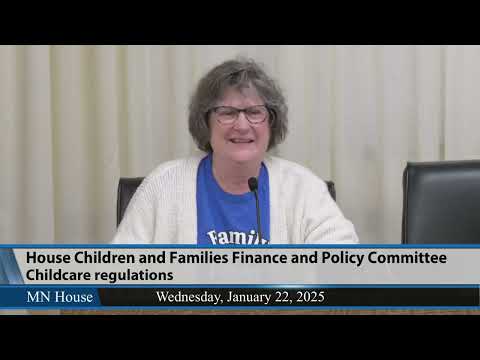
Cindy Cunningham, a Saint Paul family child care provider and public policy chair for a statewide family child care association, told the committee “The state is investing high dollars to support an increased childcare. Yet family childcare providers continue to decline. The investments aren't working. There needs to be a change. As many have stated, we are in a crisis situation.” She and other witnesses described problems that include federal food-program tiering that reduces reimbursements for many home-based providers, grant programs that require 100% upfront spending before reimbursement, and inconsistent or poorly communicated licensing guidance from the Minnesota Department of Human Services (DHS).
The testimony outlined specific financial and administrative barriers affecting home-based providers. Cunningham said providers often cannot access the higher federal food reimbursement tier because commercial or special licenses in some communities do not qualify for the family child care food program, leaving “that many more children going without financial support for food.” She asked the state to consider a supplement for providers stuck on lower reimbursement tiers and to continue the Great Start compensation investments.
On grants, Cunningham said many providers must pay 100% of expenses up front to use Parent Aware or other state grants and wait 30 to 90 days for reimbursement; she described the facilities grant as an exception that pays 90% up front and 10% on completion. Quoting providers the committee had collected in letters, Representative Zalesnikar read that “Parent Aware or Regional grants... require paying 100% upfront” and that the reimbursement delay strains small operators.
Cunningham and several legislators also criticized DHS communication and enforcement. She said DHS has not shared a recent legal determination broadly with providers and licensors and that county licensors often lack up-to-date information. “We can't get good communication from DHS,” she told the committee, describing limited staffing at county licensing offices and a period when a DHS manager position remained unfilled for months, reducing the agency’s capacity to support providers.
Lawmakers and providers pointed to the Office of Legislative Auditor (OLA) February 2024 review as a touchpoint: witnesses urged the committee to press DHS to implement the OLA recommendations and to consider routing equitable state funding directly to counties to fund licensors and local outreach. Cunningham suggested that county economic development offices could do more active recruitment of new family child care businesses if counties had direct, stable funding.
Several letters read into the record described how licensing standards and enforcement affect everyday operations. A center director quoted by Representative Zalesnikar said some statutes “are not serving the common good anymore” because requirements have become paperwork-heavy and time-consuming, pulling staff away from direct child supervision. Representative Alten Dorf read a letter from a center owner arguing Minnesota is “one of the most expensive states for child care” while also having “some of the highest regulated” licensing requirements, and urging lawmakers to simplify rules to retain providers.
The committee also heard cost context from Heather Hyer, director of the Office on the Economic Status of Women, who said the widely cited per-family child-care cost estimate “was based on Childcare Aware data from 2024” and varies by region. Several lawmakers cited larger workforce and access statistics, including that family child care numbers have fallen sharply since 2011; Representative Nadeau said the state had about 12,000 family providers in 2011 and “we have just over 6,000 family care providers today.”
No formal actions or votes were taken at the hearing. Multiple members said they plan to draft legislation addressing licensing clarity, grant reimbursement mechanics and county funding to stabilize local oversight. Committee members also noted the absence of DHS and the Department of Children, Families and Intergenerational (DCOIF) representatives at the hearing; Chair Nelson said it was “terribly unfortunate that the agencies aren't here today,” and urged agency review of the testimony if staff watched the hearing remotely.
The discussion highlighted a consistent theme: providers and the legislators who read their letters urged clearer, more consistent communication from DHS, reduced administrative barriers to small home-based businesses, and funding mechanisms that recognize differences between center-based and family child care models. Lawmakers said they will use the session to seek statutory and budgeting changes; the committee did not set a formal timeline for specific bills at this hearing.
Ending: The committee hearing concluded without agency response; members left with letters, provider testimony and a stated intent to pursue legislative fixes this session.