Get Full Government Meeting Transcripts, Videos, & Alerts Forever!
Get email alerts on the Local Government topic
No spam. Unsubscribe anytime.
League of Minnesota Cities outlines member profile and priorities to committee
Summary
Craig Johnson of the League of Minnesota Cities described the league’s membership, services and legislative priorities including funding for water and wastewater, public-safety duty disability, and sales-tax treatment for construction materials
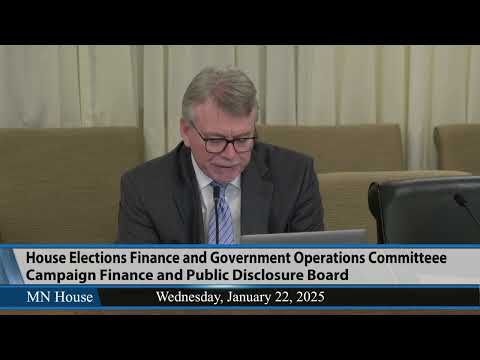
Craig Johnson, senior governmental relations representative for the League of Minnesota Cities, told the Elections Finance and Government Operations Committee the league represents 841 of Minnesota’s 856 cities and provides advocacy, training and risk management for municipalities.
Johnson said the league supports a broad set of city responsibilities and noted that most Minnesota cities are small: 706 have populations under 1,000 and 147 are in the seven-county metropolitan area. The league’s work spans police and fire services, local roads, libraries, parks, drinking water and wastewater, housing, solid waste and recycling, and economic development assistance.
On legislative priorities, Johnson pointed the committee to the league’s online policy platform and said the board annually prioritizes issues. He highlighted water and wastewater funding and the public-safety duty disability topic as major items for cities. Johnson also noted attention to specific local problems such as emerald ash borer tree losses and said the league regularly supports measures including sales-tax treatment for construction materials and local revenue tools. He told members the league expects to prepare legislation on a sales-tax exemption for construction materials this session.
Johnson described how the league coordinates with many affiliated local associations (city managers, clerks, planners, engineers and police chiefs) but does not advocate for individual city projects at the Capitol. He offered to provide follow-up material and to work with committee members on comparisons of lobbying and disclosure rules with federal standards.
Committee members asked about local-option sales taxes and construction-materials exemptions; Johnson said staff member Beth Johnston handles tax policy and would follow up. He also suggested the league can provide examples of when unelected entities’ rulemaking or mandates impose costs on cities, and he said the League can work with the committee on those topics offline.