Get Full Government Meeting Transcripts, Videos, & Alerts Forever!
Get email alerts on the Human Trafficking Training Commission topic
No spam. Unsubscribe anytime.
Panel backs expanding human‑trafficking education and immunity protections in HB1308
Summary
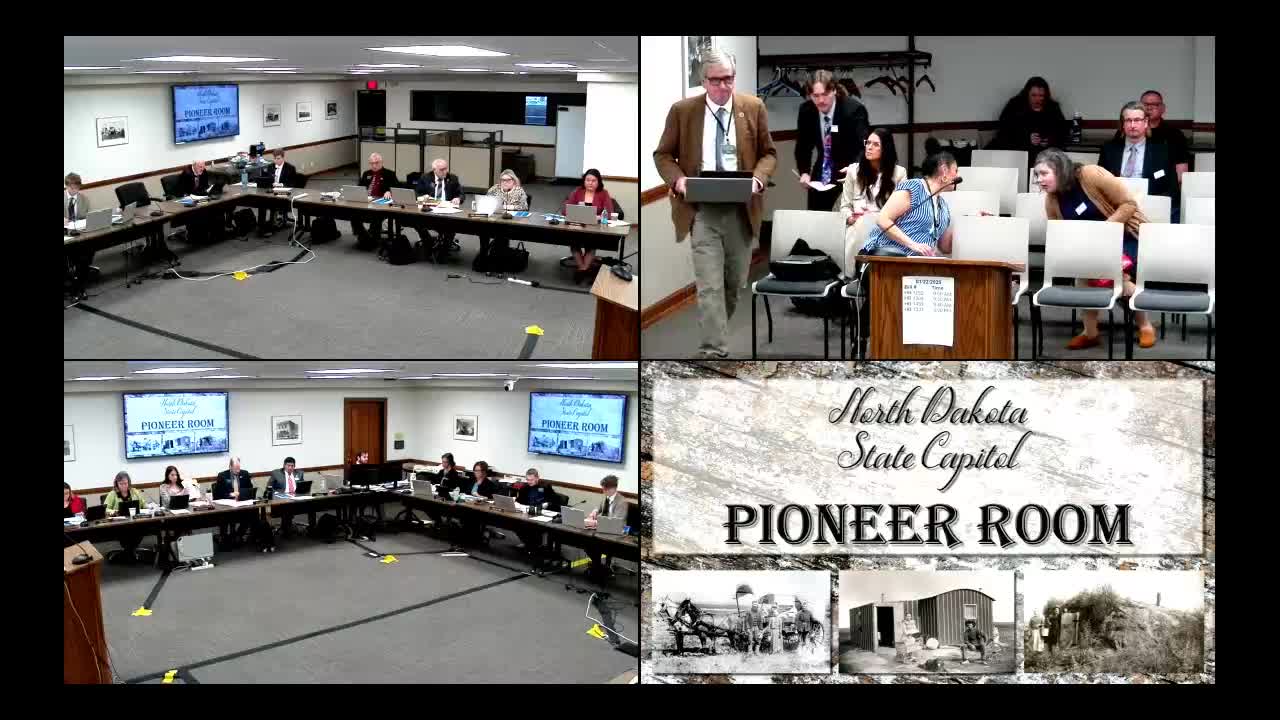
Representative Bernie Satrim presented House Bill 1308 to the House Human Services Committee, saying the bill would add more professions to the list subject to human‑trafficking training and would make the commission’s duties permanent.
Representative Bernie Satrim presented House Bill 1308 to the House Human Services Committee, saying the bill would add more professions to the list subject to human‑trafficking training and would make the commission’s duties permanent. “The objective is to have more eyes on the problem,” Satrim said, asking for a do‑pass recommendation.
The bill requires training that includes “human trafficking awareness; how to recognize potential victims of human trafficking; how to identify activities commonly associated with human trafficking; and effective responses to situations, including how to report,” as recited during committee questioning. It would permit entities that regulate occupations to accept the training for continuing‑education credit.
Witnesses described existing training resources and urged the committee to leave flexibility in the statute for how the training is delivered. Stacy Schafer, executive director of 31.8 Project, a nonprofit that provides education and services to survivors, said training length varies by audience and setting: for teachers an in‑service session may be two to three hours but shorter briefings are also used. “We adjust our time frame based on what that group allows us to utilize,” she said. She also noted Bureau of Criminal Investigation personnel provide training at the law‑enforcement academy.
Several organizations testified in support of the bill. Jacob Thompson, a policy analyst for North Dakota Family Alliance Legislative Action, said the commission and additional training “is another step” toward awareness and prevention. Christopher Dodson of the North Dakota Catholic Conference, who has completed an online course on trafficking and immigration, said lawyers and other professionals are likely to encounter victims and that profession‑specific training would be useful.
Committee members raised two recurring implementation questions: how long the training must be and how the bill’s immunity provision interacts with existing professional‑ethics rules. Satrim said the bill does not specify a single duration; the training must cover required topics and may use existing modules. On immunity, he and an association witness said the statute preserves immunity for good‑faith reporters while not superseding a professional board’s ethics enforcement — meaning a professional could have separate disciplinary exposure under their licensing body for unrelated ethical violations.
No committee vote was recorded during the hearing; committee members asked the sponsor to provide additional drafting clarifications (for example, whether the bill should state a training‑hour expectation) before floor consideration.