Get Full Government Meeting Transcripts, Videos, & Alerts Forever!
Get email alerts on the Public Safety topic
No spam. Unsubscribe anytime.
House Public Safety Committee advances multi-part public safety bill, including tougher penalties and tracking-device changes
Summary
House File 7, a package of public-safety measures largely authored by House Republicans, was advanced from the House Public Safety Committee to the Ways and Means Committee after testimony from law enforcement groups, a civil‑liberties advocate and policy researchers.
House File 7, a package of public-safety measures largely authored by House Republicans, was advanced from the House Public Safety Committee to the Ways and Means Committee after testimony from law enforcement groups, a civil‑liberties advocate and policy researchers.
Representative Novotny, chair of the House Public Safety Committee and lead sponsor, told the panel the bill “represents the priorities of the House Republican caucus in the public safety area,” adding it seeks to help law enforcement, keep “violent and dangerous offenders off the street,” and increase transparency in charging and sentencing decisions.
The bill combines about a dozen provisions drawn from prior sessions. Advocates at the hearing said the components address several recurring issues: a rise in vehicle theft and “joyriding,” assaults on officers and what witnesses described as a perceived lack of accountability in charging and sentencing decisions.
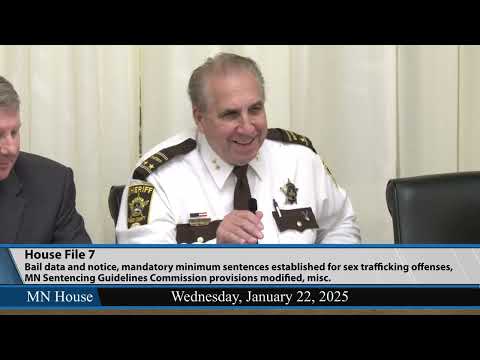
Ramsey County Sheriff Bob Fletcher said local teams have reduced auto thefts and carjackings but argued tougher criminal penalties and additional tools are needed to sustain those gains. “We would not have been able to reduce crime without pursuing suspects,” Fletcher said, adding that the bill would help officers “catch them in the car” by expanding existing fleeing and stolen‑vehicle provisions and by allowing tracking devices to be placed on unoccupied stolen vehicles in more circumstances.
Shane Myrie, president of the Minnesota Police and Peace Officers Association, told the committee the bill’s changes to the statute on fleeing in a motor vehicle and the proposed offense for “legal presence in a stolen motor vehicle” have broad support within rank‑and‑file officers. “If we’re able to slap a tracker or apply a tracker to an unoccupied vehicle, we can conduct surveillance on that vehicle,” Myrie said, adding the change would allow law enforcement to plan arrests “at a time, place, and manner that is designated by law enforcement.”
Jeff Potts, executive director of the Minnesota Chiefs of Police Association, echoed those points and cited statewide data presented to the committee. “In 2023, there were 2,006 assaults on police officers,” Potts said, and he described steady numbers of fleeing incidents and a notable rise in assaults on officers over recent years.
Policy witnesses also urged changes to transparency. David Zimmer, public safety policy fellow at the Center of the American Experiment and a former Hennepin County deputy, said House File 7 would create publicly searchable databases of county attorney dismissals, sentencing reductions and bail payments. “Public access to the data would focus . . . on more timely attention to some of the unacceptable increases in sentencing departures,” Zimmer said.
The bill’s specific criminal‑law provisions, as presented at the hearing, include: an increased felony-level penalty for assaulting a peace officer in some circumstances; a new tiered offense for being in a stolen motor vehicle (misdemeanor on first offense, gross misdemeanor on repeat); expanded aggravated fleeing language to cover more dangerous conduct short of death or great bodily harm; increased penalties for blocking highways and damaging critical infrastructure; and statutory changes to allow broader public disclosure of who posts bail and the recording of prosecutorial dismissals and sentencing reductions.
Several testifiers described operational details and limits. Sheriff Fletcher and other law-enforcement speakers said the current tracking-device law (enacted in 2022) allowed placement only when a stolen vehicle was reported occupied; the proposed change would permit placing a tracking device when an unoccupied reported-stolen vehicle is located but officer access to owner permission or a warrant is not immediately available. Fletcher emphasized a 24‑hour removal requirement in current law and told the committee officers remove trackers promptly after recovery.
Civil‑liberties advocate Rich Neumeister warned the committee that broadening tracking authority raises Fourth Amendment concerns, especially where a stolen vehicle is located in a private area or “curtilage.” “This pushes the boundaries of the 4th Amendment,” Neumeister said.
Representative Hudson offered and described amendment A1, which removes a court-imposed requirement that a person retreat if they had the ability to do so before using force to aid another person. Hudson framed the change as a correction to a Minnesota Supreme Court decision; the committee adopted the amendment by voice vote.
Committee discussion also touched on juvenile justice. Sheriff Fletcher and others raised concerns about a recent change that raises the age of delinquency from 10 to 13; Fletcher urged either phasing that change in or extending the timeline, saying the statute will limit the ability to arrest some juveniles charged with auto theft or carjacking.
The chair renewed the motion to recommend House File 7, as amended, and the committee voted by voice to advance the bill to Ways and Means. No roll‑call tallies were recorded during committee action; the transcript records voice votes and the motions as adopted.
What happens next: the bill will go to the House Ways and Means Committee for fiscal review and further action.
Speakers quoted in this story appeared at the committee hearing; direct quotes are attributed to their names and roles as recorded in the committee transcript.