Get Full Government Meeting Transcripts, Videos, & Alerts Forever!
Get email alerts on the Campaign Finance topic
No spam. Unsubscribe anytime.
Campaign Finance Board tells committee it has no-request budget, outlines local registration and lobbying reporting changes
Summary
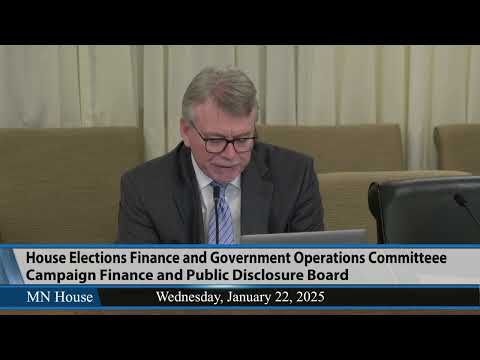
Jeff Sigurdsson, executive director of the Minnesota Campaign Finance and Public Disclosure Board, told the Elections Finance and Government Operations Committee the board is seeking no substantive change to its base budget and outlined program expansions and rule changes that the board is implementing or recommending.
Jeff Sigurdsson, executive director of the Minnesota Campaign Finance and Public Disclosure Board, told the Elections Finance and Government Operations Committee the board is seeking no substantive change to its base budget and outlined program expansions and rule changes that the board is implementing or recommending.
The board asked for no change items beyond modest inflation adjustments built into the governor’s budget request, Sigurdsson said, and presented a base biennial budget of $1,793,000. He described the agency as “an independent agency” that is included in the governor’s budget but does not report to the governor’s office.
The board administers campaign finance reporting for state candidates and party units, economic interest statements for roughly 3,100 public officials, and lobbyist registration and reporting. Sigurdsson told the committee local ballot-question committees for levies and bonds must register with the board under chapter 10A if activity exceeds $750 as of Jan. 1; previously those entities reported under chapter 211A to local officials only. He said the change will put local ballot reports on the board’s website and that the board is doing outreach and building an online registration tool for those committees.
On lobbying, Sigurdsson said the reporting regime has shifted away from marginal cost accounting toward disclosure of subjects and the entities lobbyists try to influence. He told the committee about a statutory expansion, effective June 1, that extends lobbyist registration to all political subdivisions (cities, counties, school districts, townships and others). "Starting on June 1st, lobbying is gonna be extended to all political subdivisions," he said, and added the board expects a substantial increase in registrants as a result.
The board recommended two principal changes to how the expanded lobbying regime should work: broaden the way expert testimony is treated so paid experts used to inform local public hearings are disclosed (the board would require lobbyists to report the expert’s name, the entity they testified before, and the subject matter) and narrow the trigger that now can force local government employees to register if they spend more than 50 hours in a month working with another political subdivision. Sigurdsson said the board views registration of ordinary intergovernmental staff who are coordinating public infrastructure or service delivery as unlikely to provide useful public disclosure and as a burdensome requirement.
He provided enforcement context: the board has only civil-penalty authority and follows multi-step procedures that include probable-cause findings and conciliation agreements; it also issues advisory opinions (about 430 to date) and posts reports and enforcement outcomes on its website. The board has moved most training online and is producing short targeted videos for volunteer treasurers and other filers.
Sigurdsson gave program counts and funding figures: about 650 state candidates and roughly 378 reporting political committees and funds are registered, and the public subsidy program paid $2,107,940 in 2024 to 230 House candidates (average payment about $9,000). He said the Department of Revenue reported $447,000 in political contribution refunds to candidates and $1,616,000 to party donors in 2023; he described the PCR (political contribution refund) program as an open appropriation. For 2024 subsidy funding Sigurdsson gave a split of the public-subsidy payment pool: roughly $1,517,000 from the statutory general account appropriation and about $590,000 from taxpayers’ check-off donations.
Sigurdsson also said about 1,450 lobbyists were registered to represent roughly 1,500 principals and that principals reported about $98 million spent on lobbying in 2023; he said the total likely will exceed $100 million for 2024. He noted that the principal spending figure reported to the board does not include lobbying expenditures by political subdivisions themselves.
Committee members asked follow-up questions about nonprofit lobbying, whether legislators can act as lobbyists, and implementation details for changes to the lobbying rules; Sigurdsson said nonprofits are principals if they pay more than $3,000 for representation and a staff member’s compensation can trigger an individual registration if the portion reasonably attributable to lobbying exceeds $3,000. He also said house rules already prohibit members from acting as paid lobbyists in that capacity.
The board provided a written report and two public hearings’ worth of comments as part of its recommendation packet to the legislature and said it will provide additional follow-up answers to committee questions offline.