Get Full Government Meeting Transcripts, Videos, & Alerts Forever!
Get email alerts on the K12 Education House File 6 topic
No spam. Unsubscribe anytime.
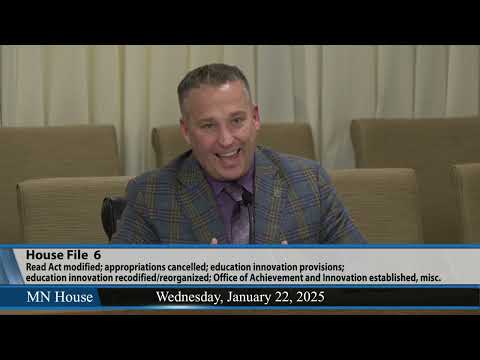
House Education Committee lays over House File 6 after presentations on literacy, local control and mandate relief
Summary
The Minnesota House Education Committee laid over House File 6 for possible inclusion in an omnibus bill after sponsors presented three articles focused on foundational literacy (science of reading), local control and education innovation, and temporary funding and mandate flexibility for school districts.
The Minnesota House Education Committee on Jan. 1, 2025 laid over House File 6 after committee members and bill sponsors presented the proposal's three-part approach to K‑12 policy: a renewed emphasis on foundational literacy, expanded local control and innovation, and near-term flexibility on funding and new mandates.
Representative Peggy Bennett, State Representative, District 23A, moved House File 6 before the committee "with the intention that the bill be laid over for possible inclusion in an omnibus bill or further action at a later date," and the chair subsequently laid the bill over for further consideration.
The bill is presented in three articles. Article 1 would revise the Reid Act enacted in the 2023–24 legislative biennium to emphasize the "science of reading" and include language stating an "unequivocal commitment to the science of reading" and that "every child has the right to read. Period," Rep. Tina Mueller, State Representative, said while explaining the article. Mueller said the bill ends a Department of Education partnership with the Center for Applied Research and Educational Improvement (CARI) in June and directs the Minnesota Department of Education (MDE) to resume the primary role in assisting schools with literacy implementation.
Article 1 also would restore teacher-preparation expectations and an assessment to verify teachers' readiness to provide reading instruction, language Mueller described as intended to address what she called implementation failures and gaps in teacher preparation.
Article 2, presented by Representative Baeckburg, State Representative, draws together existing statutory innovation programs into a new "educational innovation" chapter and shifts certain approvals from a permission-based model to one that places planning authority primarily with local school boards, superintendents and educators. Baeckburg said the bill would direct the Department of Education to produce a user-friendly performance report that consolidates metrics such as reading, math, science and college- and career-readiness. He also proposed converting the department's current Equity, Diversity and Inclusion Center into an "Office of Achievement and Innovation," whose guidance would be advisory and nonbinding for local districts.
Article 3 would give school boards temporary flexibility through the 2028–29 fiscal year (the 2028–29 school year) to transfer unencumbered funds that are not restricted by federal law, provided such transfers do not trigger additional state aid or local levy consequences. The article also would permit school boards, by public resolution, to delay implementation of many new mandates imposed in the 2023–24 biennium through the 2028–29 school year, the sponsors said. Representative Bennett framed those provisions as short-term pauses to allow districts time to implement new requirements "with fidelity."
The session laws and mandates specifically named in committee discussion included the 2023 Early Childhood Omnibus (Chapter 24), the 2023 Education Omnibus (Chapter 55), the 2024 Education Policy Omnibus (Chapter 109), the 2024 Education Finance, Children and Families Omnibus (Chapter 115), the paid family and medical leave requirement in 2023 Chapter 59, and the earned sick and safe time requirement in 2023 Chapter 53. Sponsors said the mandate‑relief language would also apply to amendments to those laws enacted during the 2023–24 biennium.
Committee members did not record a roll-call vote on the motion to lay the bill over during the excerpted discussion. The chair announced that House File 6 was laid over for possible inclusion in an omnibus bill and further consideration at a later date.
Why it matters: House File 6 addresses multiple high-profile, statewide K‑12 topics that affect curriculum and instruction (literacy), local governance and school finances. The proposal would alter state–district relationships (by shifting approvals and converting a DEI center into an advisory office), change implementation timelines for recent mandates, and change the entity responsible for supporting literacy work in schools.
Supporters in the hearing framed the bill as empowering local educators and parents and focusing state efforts on foundational literacy. Representative Mueller said the changes aim to correct what she described as implementation problems with the Reid Act and teacher preparation. Opposing or alternative views were not included in the transcript excerpt provided to this report.
Next steps: Committee sponsors said they intend to present the bill's separate components as individual legislation and pursue inclusion in an omnibus bill; the committee laid House File 6 over for possible future action.