Get Full Government Meeting Transcripts, Videos, & Alerts Forever!
Get email alerts on the Public Safety Legislation topic
No spam. Unsubscribe anytime.
House Public Safety Committee advances broad public-safety package; adopts amendment on use-of-force
Summary
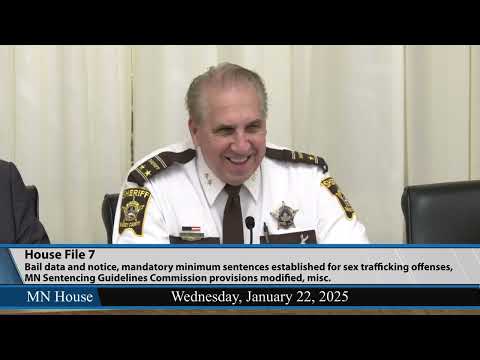
Chair Novotny, chair of the Minnesota House Public Safety Committee, opened and shepherded debate on House File 7, a multi‑part public‑safety bill the committee recommended to pass and re‑refer to the House Ways and Means Committee on Jan. 21, 2025.
Chair Novotny, chair of the Minnesota House Public Safety Committee, opened and shepherded debate on House File 7, a multi‑part public‑safety bill the committee recommended to pass and re‑refer to the House Ways and Means Committee on Jan. 21, 2025. The committee adopted a related amendment, coded House File 7A1, changing the duty to retreat in certain self‑defense situations.
House File 7 bundles about a dozen provisions the bill author described as Republican public‑safety priorities, including heightened penalties for some assaults on peace officers, increased penalties for reckless fleeing in motor vehicles, a new offense for being in a stolen motor vehicle, and expanded transparency requirements for charging, dismissals and sentencing reductions. Chair Novotny said the bill’s themes are “helping law enforcement make our communities feel safer from criminals, keeping violent and dangerous offenders off the street, and holding the criminal justice system accountable.”
Why it matters: supporters said the package responds to a documented rise in assaults on officers and auto thefts and would give law enforcement tools to reduce repeat offending. Opponents and privacy advocates raised Fourth Amendment and civil‑liberty concerns about expanded use of vehicle tracking devices.
Law‑enforcement testimony
Ramsey County Sheriff Bob Fletcher testified in support of House File 7 and described local reductions in auto theft and carjacking after aggressive enforcement, while urging additional tools to arrest repeat offenders. “You can arrest your way out of the crime problem,” Fletcher said, arguing that current law limits arrests to drivers and hampers charging passengers who “reasonably should have known” a vehicle was stolen.
Shane Myrie, president of the Minnesota Police and Peace Officers Association, told the committee that assaults on officers and dangerous fleeing incidents have increased and that members back several provisions, including a tiered approach to criminalizing presence in a stolen vehicle and removing the requirement that a reported stolen vehicle be occupied before a mobile tracking device may be applied.
Jeff Potts, executive director of the Minnesota Chiefs of Police Association, also supported the bill’s prosecutorial and judicial transparency provisions and the fleeing‑and‑tracking changes. Potts cited statewide data the association has referenced showing increases in assaults on officers and in fleeing cases.
Privacy and legal concerns
Rich Neumeister, an open‑government advocate who has worked on privacy and open‑records issues since the 1970s, opposed expanding the tracking exception without continued safeguards. Neumeister said the 2022 compromise language that restricted deployment raised important privacy considerations and warned the current changes “push the boundaries of the Fourth Amendment.”
Policy and data proponents
David Zimmer, Public Safety Policy Fellow at the Center of the American Experiment and a former Hennepin County sheriff’s deputy, supported the bill’s data‑transparency provisions, saying publicly searchable sentencing and dismissal data would allow researchers and policymakers to evaluate charging and sentencing outcomes more effectively.
Key provisions discussed
- Fleeing in a motor vehicle: testimony and the bill text propose increased penalties to fill the gap between simple fleeing and fleeing that causes death or great bodily harm. Supporters said the change would deter high‑risk behavior such as driving the wrong way or on sidewalks.
- Illegal presence in a stolen vehicle: the bill would create a new offense with a misdemeanor for first offense and escalation to gross misdemeanor for repeat conduct, aimed at establishing records for juveniles and repeat offenders.
- Vehicle tracking devices: House File 7 would remove the requirement that a reported stolen vehicle be occupied before law enforcement may apply a mobile tracking device, allowing tracking during active fleeing incidents so officers can stage safer arrests.
- Assaults on peace officers: the bill increases penalties for assaults on officers and supporters urged aggravated sentencing where there are prior convictions or demonstrable bodily harm.
- Transparency measures: the bill would create publicly searchable databases for county attorney dismissals and criminal sentencing reductions and require greater disclosure about who posts bail, supporters said to improve public confidence and oversight.
Amendment and committee action
Representative Hudson offered amendment House File 7A1 to clarify that a person may use force to aid another even if they had the ability to retreat; the amendment responds to a Minnesota Supreme Court decision changing the duty‑to‑retreat analysis. Chair Novotny called the amendment friendly, asked for a green vote, and the amendment was adopted by voice vote. Chair Novotny then renewed the motion that House File 7, as amended, be recommended to pass and be re‑referred to the Ways and Means Committee; the committee approved the motion by voice vote. The clerk recorded a voice vote; no roll‑call tally was entered in the hearing transcript.
Questions from committee members
Committee members queried witnesses about juvenile involvement in carjackings, whether gangs recruit juveniles, and whether stolen property carries an expectation of privacy. Sheriff Fletcher said some juveniles identify with “gangs” but often without organized hierarchy and that a substantial number of repeat thefts involve youth. On expectation of privacy, Fletcher said in his view a thief of a vehicle does not have an expectation of privacy that would bar tracking the vehicle.
Dissenting perspectives and legal limits
Neumeister and others urged caution about the scope of tracking authority and stressed existing safeguards in prior law. Several testifiers and committee members discussed limits imposed by court decisions, prosecutorial policies, and consent decrees that can affect enforcement choices.
Next steps
Chair Novotny said the next stop for House File 7 is the House Ways and Means Committee, where the bill will be considered in the budget context.
Ending
House File 7 was recommended to pass and be re‑referred to Ways and Means on Jan. 21, 2025. The committee adopted the A1 amendment adjusting retreat rules and heard extensive testimony from law‑enforcement representatives, privacy advocates and policy analysts.