Get Full Government Meeting Transcripts, Videos, & Alerts Forever!
Get email alerts on the Data Centers topic
No spam. Unsubscribe anytime.
Lawmakers hear data‑center industry, utilities and community groups on power needs and grid impacts
Summary
Minnesota Senate Energy, Utilities, Environment and Climate Committee members heard more than three hours of testimony on how large data centers could affect Minnesota’s electric system, the economy and local communities.
Minnesota Senate Energy, Utilities, Environment and Climate Committee members heard more than three hours of testimony on how large data centers could affect Minnesota’s electric system, the economy and local communities.
Committee members heard that utilities have been approached about very large loads, that planning and contractual terms will shape whether those projects help or strain ratepayers, and that local siting, water use and transparency remain immediate concerns.
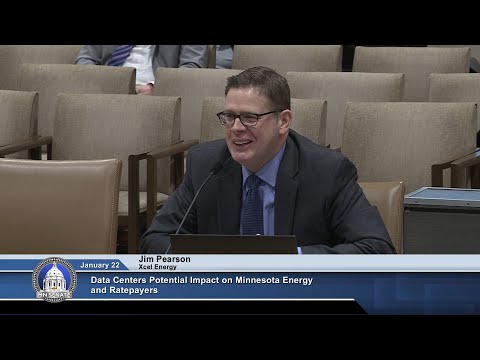
The committee convened with Cochair Mark Frentz and Cochair John Matthews presiding; the panel heard from Xcel Energy, the Minnesota Chamber of Commerce, electric cooperatives and consumer advocates, among others. “We’re excited,” said Jim Pearson, an Xcel Energy representative, as he opened the discussion and described the utility’s interest in partnering with data‑center operators. Pearson said utilities use long‑range integrated resource planning and that the company follows a “cost causer” principle: customers pay for the specific capital investments needed to serve them and other costs are recovered through rates.
Why it matters: several witnesses said data centers can bring investment, new generation and rate‑stabilizing load, but those potential benefits are not automatic. Consumer and community advocates urged firm contracts that protect existing customers from bearing stranded costs; local groups raised siting, water and noise concerns.
Most significant testimony and details
- Jim Pearson, representing Xcel Energy, told the committee the utility is “eager to partner with the data center industry.” He described integrated resource planning as an 18‑month process that models 15 years of demand and treats different load scenarios publicly through the Public Utilities Commission process.
- Michelle Benson, director of Commerce and Energy Policy for the Minnesota Chamber of Commerce, said broader economic forecasts and AI growth are driving data‑center investment and that the Chamber sees the centers as a potential source of jobs and investment while calling for workable permitting and attention to energy and water use. “AI is coming, and we’re going to be part of it whether we choose it or not,” Benson said.
- Ryan Hentges, chief executive officer of Dakota Electric Association, told the committee his cooperative has received inquiries “totaling over 3 gigawatts worth of electric service” in its territory, though he said not all inquiries are expected to develop. He said data centers can pay for transmission and generation upgrades and provide rate stability by increasing kWh sales.
- Annie Levinson Faulk, executive director of the Citizens Utility Board of Minnesota (CUB), urged protections for residential ratepayers: require reservation payments, “take or pay” provisions and greater transparency in contracts between utilities and data‑center customers so the Public Utilities Commission can assess the full cost to serve.
- Aaron Tindham, vice president of energy for the Data Center Coalition, said the industry is pursuing efficiency and that data centers are significant buyers of contracted renewable energy. He noted data centers’ operating models make energy a large share of their operating costs and argued that industry actors are incentivized to pursue efficiency.
- Deb Bergin of Missouri River Energy Services and other municipal and cooperative utility speakers flagged “infrastructure fatigue”: large, repeated transmission projects can prompt landowner pushback and raise community concerns about siting long transmission corridors.
Community and consumer concerns
Local advocacy groups and residents testified on siting, water use and tax incentives. Kathy Johnson, president of the Coalition For Responsible Data Center Development, said several hyperscale proposals in Dakota County are seeking hundreds of megawatts each and called for zoning rules and stronger oversight to ensure benefits accrue to local communities and ratepayers. Consumer advocates warned that benefits to consumers are not automatic and urged contractual protections to prevent ratepayers from shouldering infrastructure costs if a project does not follow through.
Discussion vs. decision
The hearing was primarily testimonial and informational. No committee votes were recorded on data‑center proposals at this session. Witnesses and committee members discussed: current utility forecasts and integrated resource planning; contract terms (reservation payments, “take or pay” language); potential near‑term solutions such as distributed generation and batteries; and longer‑term generation options, including nuclear and additional renewables. Utilities emphasized they rely on regulatory review through the PUC and resource planning to determine how to serve large customers.
Clarifying details raised in testimony
- Dakota Electric reported inquiries “totaling over 3 gigawatts” in its service territory (Ryan Hentges). - Xcel Energy said its current integrated resource plan contains roughly 450 megawatts of load scenario related to recent inquiries and company leadership has discussed pursuing about 1,000 megawatts by 2032 (Jim Pearson). - Utilities described an 18‑month integrated resource planning cycle and noted that generation and transmission investments can take years and require regulatory approvals.
What’s next
Committee members reserved questions until the end of the panel and signaled the committee will continue the conversation in future hearings. There were no formal actions taken on data‑center policy during this meeting.
Ending note
Testimony made clear that whether data centers become a net benefit for Minnesota ratepayers will depend on the contractual arrangements utilities and developers sign, the speed and scale of development that ultimately materializes, and how regulators and local governments manage siting, permitting and transparency.