Get Full Government Meeting Transcripts, Videos, & Alerts Forever!
Get email alerts on the Tax Administration topic
No spam. Unsubscribe anytime.
Bill would limit retroactive tax assessments when taxpayers relied on prior audit guidance
Summary
Senate File 88 would curb the Department of Revenue’s ability to assess additional sales or income taxes when a taxpayer relied in good faith on prior audit treatment and the underlying statute, rule or federal return has not materially changed; the department provided examples of how sample audits are treated.
Senate File 88, authored by Senator Cline, would restrict the Commissioner of Revenue’s ability to issue retrospective assessments for income or sales taxes when taxpayers can show they relied in good faith on prior written audit guidance and there has been no material change in statute, administrative rule, a controlling court decision, or federal adjustment.
Cline said the bill addresses situations where taxpayers “believe in good faith that they are following existing tax policy and they have been subjected to an audit and are trying to abide by that audit, and then suddenly have an additional tax burden, sometimes retroactive, based on a reinterpretation of tax law by the department.” The committee adopted an A1 amendment and a subsequent clarifying amendment before receiving testimony.
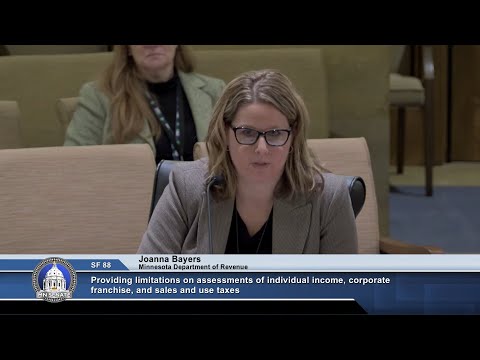
Joanna Baerz, legislative director at the Minnesota Department of Revenue, outlined how sample audits work and offered an illustrative example involving a retailer and the tax status of “honey roasted nuts.” Baerz said that if a specific issue was not included in an audited sample, a later audit could discover the issue and an assessment might be issued; if the sample audit did address the item and the department missed it, later discovery would generally require prospective correction but not retroactive assessment for that specific issue.
Gino Fragnito, government relations director at the Minnesota CPA Society, said the bill “will provide some reassurance” to taxpayers who followed auditor guidance and later face inconsistent interpretations. Supporters including the Chamber of Commerce provided written backing, and several senators characterized the bill as a taxpayer-protection measure that preserves department flexibility going forward.
The committee laid Senate File 88, as amended, over for possible inclusion; a fiscal estimate was not available at the hearing.