Get Full Government Meeting Transcripts, Videos, & Alerts Forever!
Get email alerts on the Rethinking I94 Public Engagement topic
No spam. Unsubscribe anytime.
MnDOT says it will reconsider advisory‑committee role after PAC members pressed to study ‘at‑grade’ I‑94 boulevard option
Summary
At the Jan. 22 hearing, senators and community advocates pushed MnDOT to give its Rethinking I‑94 policy advisory committee a more meaningful role after MnDOT excluded at‑grade boulevard options from near‑term recommendations. MnDOT said it would re‑engage PAC members and consider process changes.
Senators and MnDOT officials clashed over process and analysis for the Rethinking I‑94 project on Wednesday, after advisory‑committee members and local leaders urged the agency to continue studying at‑grade (boulevard) options and the economic potential of repurposing highway land.
Senator [distinctly identified in the transcript as] McEwen said she was “dismayed” that MnDOT had ruled out at‑grade boulevard options and had not included economic repurposing in the agency’s analysis, citing an independent report that estimated thousands of jobs and housing units could result from converting highway acreage. McEwen urged MnDOT to make advisory participation meaningful and to give the policy advisory committee (PAC) the ability to record collective recommendations.
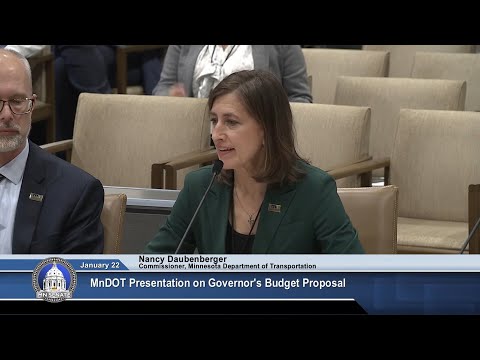
MnDOT Commissioner Nancy Daubenberger responded that the PAC had been established as an advisory, discussion‑focused body and that MnDOT records members’ input in meeting notes rather than taking formal votes. Daubenberger said the agency had “taken that under advisement” after strong PAC feedback at a recent meeting and that MnDOT would engage PAC members about how to make participation more meaningful. She promised to pursue changes “expeditiously” while consulting PAC members on preferred procedures.
MnDOT staff also described the technical work behind alternatives analysis. Eric Rudine, MnDOT government‑affairs director, and other MnDOT staff said the agency has run traffic‑diversion and corridor‑impact modeling that looks at parallel corridors (for example University Avenue and regional freeways) and estimates how much traffic would shift if parts of I‑94 were converted. Rudine told the committee that since 2018 MnDOT staff time on the Rethinking I‑94 project totaled roughly $3.9 million; consultant contracts and public outreach added about $15.4 million, for a combined planning total of about $19.25 million to date.
Senators raised operational concerns: members noted I‑94 carries heavy daily traffic (MnDOT cited roughly 167,000 vehicles per day on the corridor), proximity to hospitals and regional traffic patterns, and asked whether diverting traffic to other routes would create congestion and safety or air‑quality problems at parallel corridors. MnDOT officials said the modeling shows some traffic diverting to I‑35E, Highway 36 and regional highways, but also that certain trips “evaporate” when facilities are constrained (drivers choose not to make trips). Officials characterized at‑grade options as having notable impacts on intersection congestion and air quality, and said those factors influenced preliminary recommendations.
Several senators and local leaders said the public and city councils had shown consistent support for at‑grade options and for studying economic reuse. They urged MnDOT to give the PAC a formal role to record shared positions. Daubenberger acknowledged the need to ensure PAC members feel meaningfully engaged and said the agency will consult PAC members on how best to do that before making final decisions.
MnDOT said it plans an official public comment period next year on finalized recommendations and that it will share more analysis and modeling with the committee and interested legislators.