Get Full Government Meeting Transcripts, Videos, & Alerts Forever!
Get email alerts on the Agriculture Programs topic
No spam. Unsubscribe anytime.
Minnesota Department of Agriculture details grants, SAF tax credit and staffing risks as budget tightens
Summary
Commissioner Tom Peterson and Deputy Commissioner Andrea Vaubel briefed the Senate agriculture committee on Jan. 22, 2025, outlining program activity — from farm-to-school and beginning-farmer grants to a state sustainable aviation fuel tax credit — and warned of federal funding cuts that could constrain inspections and laboratory testing.
Commissioner Tom Peterson of the Minnesota Department of Agriculture told the Senate committee on Wednesday that the department is managing a wide portfolio of grant programs and regulatory duties while facing pressure from declining federal matches and evolving program demands.
The briefing summarized program activity across farm-to-school grants, beginning farmer assistance, soil-health cost-share, nitrate-mitigation efforts in southeast Minnesota, new green-fertilizer and CDFI technical-assistance grants, and implementation of a state sustainable aviation fuel (SAF) tax credit. "I love being a chief cheerleader for all of our different parts of agriculture in Minnesota," Peterson said as he walked senators through the agency's work.
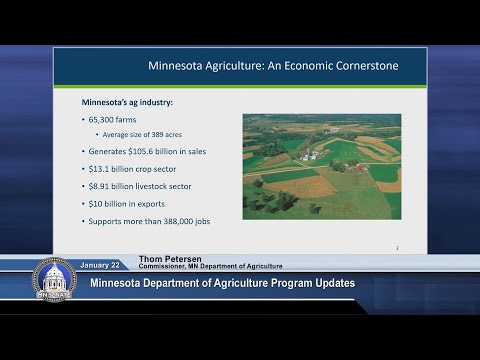
The Department emphasized why the programs matter: Minnesota has about 65,300 farms and a diversified production base that includes sugar beets, hogs, turkeys, corn and soybeans, and dairy. The department's current biennial budget is roughly $396,000,000 and it employs about 508 people across a mix of permanent and seasonal roles.
Program highlights and near-term details
- Farm-to-school: The department said it awarded nearly $1 million in the previous year across 62 purchase grants and 17 equipment grants and expanded eligibility to early care providers. The agency has signed a cooperative agreement with USDA that could bring up to $13 million for local foods in schools in the coming biennium and requires a state plan by April 30, 2025. The department noted the federal funds include no administrative allowance and will require further budget discussion with the Legislature.
- SAF tax credit: Deputy Commissioner Andrea Vaubel described the 2023 state tax credit for sustainable aviation fuel — a $1.50-per-gallon credit for SAF produced or blended in Minnesota through June 30, 2030 — and the agency's role in certifying applicants. The department said $11.6 million is appropriated for fiscal years 2025–27 for the credit; officials are developing an allocation and certification process with the Department of Revenue and are tracking private-sector initiatives such as the Minnesota SAF Hub Partnership.
- Beginning farmer and down-payment programs: The department reported an $800,000 beginning-farmer equipment and infrastructure program for FY25. The first round drew roughly 1,100 eligible applications requesting about $16.8 million, far exceeding available funds. A down-payment assistance program offering $15,000 per award has made 71 awards across the first two rounds.
- Soil health and conservation grants: The agency described a soil-health equipment cost-share program that offers 50% assistance; that program received combined legislative and clean-water funding (committee/general-fund and Clean Water Fund) and expanded in 2024. The department also reported a USDA Natural Resources Conservation Service (NRCS) urban farm conservation mini-grant of $200,000 to support commercial urban growers.
- Nitrate mitigation in southeast Minnesota: The department said it has installed 126 reverse-osmosis systems for private wells as of Jan. 16 and has 173 additional applicants pending. Officials said local testing and engagement by local units of government are the primary limiting factors for installation pace; they did not give a definitive final capacity estimate.
- Green fertilizer and CDFI technical-assistance grants: The department opened a request for proposals for a green fertilizer grant program to support projects by agricultural and rural electric cooperative companies; applications are due March 18, 2025. A one-time Community Development Financial Institution technical-assistance appropriation of about $270,000–$275,000 drew several eligible applications; contracts are under way but recipients were not named yet.
Inspection, laboratory and federal funding risks
Peterson and Deputy Commissioner Vaubel warned the committee that reductions in federal matching funds and program grants are straining inspection and laboratory capacity. The department said about 10% of its budget is federal funds and cited proposed FDA and USDA reductions that contribute to an estimated funding shortfall of roughly $2.5 million projected for fiscal year 2026 if trends continue.
Katherine Simon, director of the Department's Food and Feed Safety Division, said the agency is proposing a licensing modernization to update a structure that dates to the 1970s and to align fees and license types with modern, diversified food business models, including mobile vendors where the department has authority. She said a multi-agency work group that includes the Department of Health is active on mobile-food licensing and other reforms.
Meat inspection and lab capacity: The department reported a federal match shortfall for meat inspection. USDA provided about $2 million in federal match in federal FY24, which the department said was roughly 19% short of the expected 50% match; the department used general funds as a bridge. Officials warned that continued reductions in federal match would force personnel reductions and could reduce testing for pathogens such as Listeria and lower inspection frequency.
Cooperatives: The department submitted a cooperative financial work-group report after two convenings (one with producers/members and one with cooperative managers). The report did not recommend new mandatory financial-reporting requirements for cooperatives, citing existing statutes and cooperative governance principles, but recommended improved member communication and transparency options.
Why this matters: scale, supply and preparedness
Committee members pressed officials on practical impacts: whether current emergency funds can sustain testing through the fiscal year; the department said the answer depends on outbreak patterns and migratory bird behavior, which drive outbreak numbers. Peterson said the department maintains an agricultural emergency account and on-hand supplies to respond quickly, but cautioned that larger or simultaneous outbreaks increase costs and staff demands.
Ending
Peterson and Vaubel asked committee members to weigh in on administrative details for federal grants that require state planning (notably the USDA local-foods cooperative agreement) and on licensing modernization proposals. The department said staff will follow up with more detailed cost and award lists upon request and continue coordination with the Board of Animal Health on disease responses.