Get Full Government Meeting Transcripts, Videos, & Alerts Forever!
Get email alerts on the Transportation Budget topic
No spam. Unsubscribe anytime.
MnDOT asks legislature for trunk highway funding for eight priorities including Blatnik Bridge and corridor planning
Summary
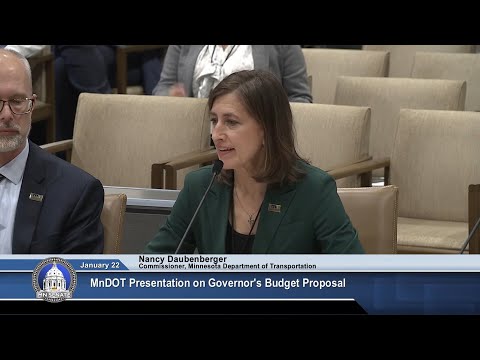
The Minnesota Department of Transportation on Wednesday asked the Senate Transportation Committee for new trunk‑highway spending authority and other changes to support eight priorities, including construction authority for the Blatnik Bridge, a new corridor‑planning base, and funding for recruitment and truck‑station modernization.
The Minnesota Department of Transportation on Wednesday asked the Senate Transportation Committee for new and continued trunk‑highway funding and statutory changes to support eight agency priorities, including construction authority for the Blatnik Bridge project, statewide corridor planning and continued funding for MPO planning.
In remarks to the committee, MnDOT Commissioner Nancy Daubenberger summarized the administration’s package as “six through trunk highway funds, one with mostly trunk highway funds and a small amount of general funds, and one with the state airport fund,” and said the trunk highway fund’s current balance makes the requests feasible now.
The package includes requests to: cover operating pressures (personnel, IT and service cost inflation); add state road construction appropriation authority to spend additional federal formula dollars; create a separate spending authority for the Blatnik Bridge tied to a federal INFRA grant (MnDOT projects construction beginning in 2026 and major work through about 2030); modernize aeronautics revenues and increase the State Airport Fund; increase metropolitan planning organization (MPO) planning grants; create a $3 million base for corridor planning to integrate local land‑use and highway planning; invest $765,000 in recruitment and retention (including five additional HR FTEs and staff‑support programs); and add $3.2 million for truck‑station facilities modernization.
Krista Boyd, the committee’s transportation fiscal analyst, gave the committee a primer on transportation finance that framed the requests. Boyd said the Highway User Tax Distribution Fund (HUTDF) remains the cornerstone of state transportation finance. She summarized key revenue and distribution points: a forecasted biennial HUTDF of roughly $6.4 billion for FY26‑27; gas tax revenue of about $2 billion (the tax base rate is 25¢ plus a 3.5¢ debt‑service surcharge indexed to inflation, yielding roughly 31.8¢/gallon as of January 2025); motor vehicle sales tax (MVST) at 6.875% with 60% of MVST going to HUTDF; and the distribution formula that apportions 62% of HUTDF to the Trunk Highway Fund, 29% to County State Aid and 9% to Municipal State Aid. Boyd also highlighted the Transportation Advancement Account (TAA), a newer account forecast at about $148 million for the 2026‑27 biennium, driven primarily by a 50¢ retail delivery fee on deliveries above $100 (pretax) with some statutory exemptions for groceries and medical deliveries.
On the Blatnik Bridge, Daubenberger told senators MnDOT is seeking separate budget authority to manage a large federal award (the Minnesota share of an INFRA grant) to keep accounting and project management explicit; she said the federal award is about $650 million and that construction is expected to begin in 2026. When asked, she said the major portion of construction will run about four years through roughly 2030.
Senators asked follow‑up questions about several items. On corridor planning, staff described the proposal as funding approximately six corridor planning studies per year; MnDOT officials said a corridor is defined by the highway designation and the system of roadways and communities it serves rather than by a fixed length. On recruitment and retention, MnDOT said the $765,000 request would add five HR FTEs and fund programs to improve onboarding speed, organizational wellness and other incentives. Sam Brown, MnDOT budget director, said the facilities modernization request is targeted at maintenance needs (doors, roofs, HVAC at truck stations) and not large capital projects, and that eligibility rules and MMB guidance affect whether trunk highway bonds or trunk highway base funding are appropriate for specific projects.
On transit funding, Boyd and MnDOT staff reviewed that transit operations rely on a mix of general fund appropriations, the Transit Assistance Fund (MVST portion), and regional sales tax revenues in the Twin Cities; MnDOT emphasized that state transit funding and trunk highway funding are distinct streams and that federal transit and highway funds are appropriated directly into the appropriate funds.
Committee leaders and MnDOT agreed to return for more detailed hearings and public testimony when the governor’s budget language and MMB narrative are formally posted. MnDOT officials said several of the requests require statutory language changes or appropriation extensions rather than new program starts.
Members of the committee pressed MnDOT for additional detail about project scheduling, eligibility for bonding vs. base appropriations, and metrics MnDOT will use to measure progress on recruitment. Daubenberger and staff said they would provide follow‑up materials to committee members.