Get Full Government Meeting Transcripts, Videos, & Alerts Forever!
Get email alerts on the Program Integrity topic
No spam. Unsubscribe anytime.
Legislative auditor and DHS outline gaps and proposals to curb waste, fraud and abuse in human services
Summary
Saint Paul — The Minnesota House Committee on Human Services heard a series of audits and briefings on Jan. 22 that described widespread weaknesses in how state human‑services dollars are awarded, monitored and recovered, and that proposed a mix of policy, technology and staffing changes to strengthen program integrity.
Saint Paul — The Minnesota House Committee on Human Services heard a series of audits and briefings on Jan. 22 that described widespread weaknesses in how state human‑services dollars are awarded, monitored and recovered, and that proposed a mix of policy, technology and staffing changes to strengthen program integrity.
The Office of the Legislative Auditor told the committee that state grantmaking and oversight show persistent gaps, the Minnesota Board on Aging lacks required monitoring of the senior nutrition program, and the Department of Human Services has not actively collected tens of millions in Medicaid provider overpayments. Department leaders described current enforcement work and a governor-backed anti‑fraud package that would expand data sharing, add surveillance tools and strengthen authority to withhold payments.
The audits matter because the state spends large sums through grants and fee‑for‑service programs, and failures in controls can reduce services to people the programs are intended to help, auditors said.
Miss Randall, a presenter from the Office of the Legislative Auditor, told the committee the OLA focused on three areas: grants management, oversight of grantees, and recovery of overpayments. “We focus a lot on internal controls, which I really think are the — it’s just the foundation,” she said, noting the work spans awarding through closeout.
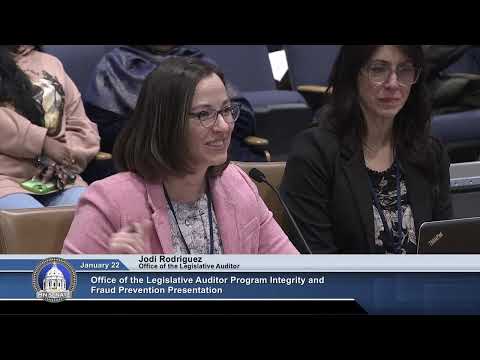
Jody Munson Rodriguez, Deputy Legislative Auditor for the program evaluation division, summarized findings from a 2023 report on front-end grant award processes. She said reviewers’ conflict‑of‑interest forms were missing or incomplete in several instances and that required pre‑award financial reviews were not documented for many grants. “At the time of our review ... the Office of Grants Management required pre‑award financial reviews for awards of more than $25,000,” she said, and in the OLA sample the issues affected roughly $11.5 million of grant funding.
Lori Lisen, Deputy Legislative Auditor for the Financial Audit Division, outlined audit findings for the federally funded senior nutrition program administered through the Minnesota Board on Aging and seven area agencies on aging. Lisen said the program provided about 3.1 million meals to more than 40,000 participants in 2022 but that auditors found nine findings across documentation, monitoring, contract oversight and participant recertification. "We found that the Board on Aging did not perform monitoring visits since 2017 and did not perform financial reconciliations in 2022," Lisen told the committee, and auditors documented hundreds of participant files with missing or inaccurate recertification.
On recovery of overpayments, the OLA audit found the Department of Human Services certified to Minnesota Management and Budget a provider‑debt balance of about $51.7 million across roughly 2,500 providers and that DHS had not attempted to recover more than $40 million of outstanding overpayments. Auditors reported that some large balances dated back many years, that records supporting adjustments are often missing because detailed claim data are retained for only three years, and that DHS has not updated its assumptions about what portion of debt is uncollectible since 2019.
Commissioner Jodi Harpstead said DHS takes the findings seriously and is implementing recommendations. "We have implemented the recommendations from the grants‑management audit ... including all of our conflict‑of‑interest forms and our pre‑award risk assessments now filed away in our contracts integration system," she told the committee. Harpstead also described ongoing work in the Department’s Office of Inspector General to stop payment and disqualify actors when fraud is suspected and said the agency routinely refers cases to state and federal prosecutors.
Harpstead and DHS officials described the governor’s anti‑fraud package, which would expand interagency data sharing, clarify payment‑withhold authority, prohibit kickbacks, strengthen surveillance tools (including analytics and AI), and introduce provisional licensing and stricter revalidation for certain rapidly growing unlicensed services such as early intensive developmental and behavioral interventions (EIDBI). “We need to build the oversight structure around those services that have been growing,” Harpstead said.
County and local officials urged greater investment in technology and simplification of eligibility rules. Matt Freeman of the Association of Minnesota Counties and Crystal Laviska, a county financial assistance manager, told the committee counties want to help detect fraud but are stretched thin and need statewide tools and predictable funding. "Outdated, glitchy, unreliable technology that doesn't allow our various programs to talk to each other is just not going to help us identify and track fraud," Laviska said.
Otter Tail County Attorney Michelle Aldean urged changes to application and renewal processes for public benefits, saying online auto‑renewals and remote enrollment can hinder timely detection. "One of the bigger things ... is the auto renewals are out of these automatic. We would suggest that you take a look at where there could be a mandatory renewal that's done annually," she said.
Provider and advocacy witnesses raised separate concerns. Attorney Matthew Bergeron told the committee that broad administrative definitions of “abuse” can produce heavy enforcement and repayment demands for imperfect paperwork even where services were provided. "When we focus on deeming those things as abuse, I think is when we miss some of the opportunities ... to go after intentional fraud," he said, urging attention to due process and targeted enforcement.
Advocates representing autistic people pressed for oversight of applied behavior analysis (ABA)/EIDBI providers, arguing licensing and stronger safeguards are needed to protect vulnerable clients and state dollars. "ABA providers need increased oversight, including licensing," said Jules Edwards. Maren Christensenhofer of the Multicultural Autism Action Network urged lawmakers to include families in design of reforms, saying long waits for diagnosis and services leave families desperate for care.
The committee did not take formal votes but several senators signaled interest in pursuing legislative fixes during the session. Members said they would review OLA reports in detail and expect bills and budget proposals in the coming weeks to address data tools, grants management, provider screening and the governor’s anti‑fraud proposals.
The hearing highlighted tensions between swift action to stop improper payments and ensuring due process for providers; several witnesses urged that reforms be targeted so enforcement focuses on intentional, criminal fraud while reducing preventable errors and improving program access.
The committee said it will follow up with additional hearings and expects agency briefings and proposed legislation later in the session.