Get email alerts on the Solid Waste Policy topic
No spam. Unsubscribe anytime.
Connecticut DEEP frames statewide solid-waste strategy, highlights pilot grants and planned waste study
Summary
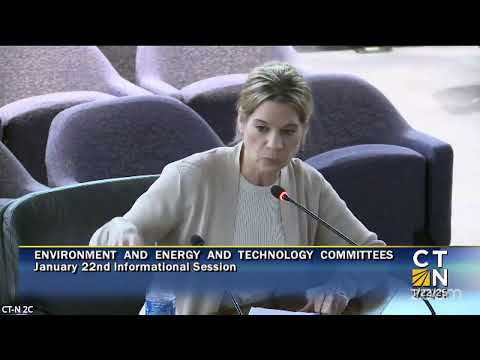
Commissioner Katie Dykes, commissioner of the Connecticut Department of Energy and Environmental Protection, told a joint forum of the Legislature’s Environment Committee and Energy & Technology Committee that the state must rebuild its in‑state approach to municipal solid waste management.
Commissioner Katie Dykes, commissioner of the Connecticut Department of Energy and Environmental Protection, told a joint forum of the Legislature’s Environment Committee and Energy & Technology Committee that the state must rebuild its in‑state approach to municipal solid waste management.
“Connecticut has had a long standing commitment to maintaining self sufficiency in our ability to manage municipal solid waste as a policy priority within the state,” Commissioner Dykes said, summarizing DEEP’s updated Comprehensive Materials Management Strategy (CMMS) and the agency’s statutory charge to amend the statewide solid‑waste plan.
The agency briefed legislators on three near‑term items: results from Sustainable Materials Management (SMM) pilot grants, a second round of SMM funding authorized by the legislature, and a planned waste characterization study. The CMMS and the SMM program are central to DEEP’s stated aim of increasing diversion — recycling and composting — ahead of disposal.
DEEP described the state’s recent shift after the 2022 closure of the MIRA waste‑to‑energy facility, saying the loss removed roughly one‑third of in‑state disposal capacity and has driven more tonnage out of state. DEEP told the committees Connecticut generates about 2,300,000 tons of municipal solid waste (MSW) annually and that roughly 860,000 tons — about 40% of the state’s MSW since MIRA closed — are now going to out‑of‑state landfills, pushing up tip fees for towns and businesses.
The SMM pilot program, funded originally with $10 million authorized by the legislature, awarded about $4.2 million across 15 municipalities, two councils of governments and one regional waste authority. DEEP said participating pilots diverted nearly 1,270 tons of food scraps, produced an average 12% decrease in waste tonnage among participants and an average 27% increase in diversion rates. DEEP characterized the pilots as “promising,” saying the results came from short‑term, voluntary pilots and that permanent, uniform programs would likely increase capture and diversion further.
DEEP said it will ask the legislature’s additional funding to support a second round of SMM grants and reported it plans to allocate about $1,000,000 from that funding to a statewide waste characterization study. Commissioner Dykes said the study’s scope will be posted shortly and that DEEP is soliciting feedback from municipalities and stakeholders on study design.
The commissioner also described technical assistance to councils of governments and towns considering regional waste authorities, and a new competitive round of solid waste infrastructure grants designed to upgrade transfer stations and other local facilities. DEEP emphasized its dual role in both diversion programs and permitting for developers exploring new disposal options.
Why it matters: DEEP framed the work as an effort to reduce Connecticut’s dependence on out‑of‑state disposal and to stretch existing in‑state capacity by improving recycling and organics diversion, while also preparing for the need to site or permit new handling capacity. The agency’s announced waste characterization study and the second round of SMM grants set a near‑term agenda for legislators and municipal officials.
DEEP asked legislators and municipal leaders to help spread pilot results and to engage in the coming design work. The agency also reiterated that any shift in state policy will need to pair incentives, technical support and funding, rather than rely solely on mandates.
The committees heard the DEEP briefing at the start of a longer conversation that included municipal leaders and private and nonprofit operators; subsequent presentations addressed pilot programs, unit‑based pricing, food‑scrap collection, private‑sector proposals for new processing capacity and municipal infrastructure needs.
AI generated
The text on this page is AI generated. Summaries, highlights, analysis, and video transcripts are all produced from the original source material.
AI can make mistakes, so if you spot one, and we will fix it for everyone.
Note: the source content is unaltered by us. Any content source we link to, be it a video, an audio recording, or a document, is presented exactly as its publisher released it. That publisher is usually a government body, sometimes an individual official or another organisation.