Get Full Government Meeting Transcripts, Videos, & Alerts Forever!
Get email alerts on the Technology topic
No spam. Unsubscribe anytime.
Katy ISD survey: Chromebooks widely used daily but parents and teachers flag battery, Wi‑Fi and weight issues
Summary
Katy Independent School District officials presented fall 2024 survey results showing high student use of Chromebooks but recurring concerns about battery life, Wi‑Fi and device comfort.
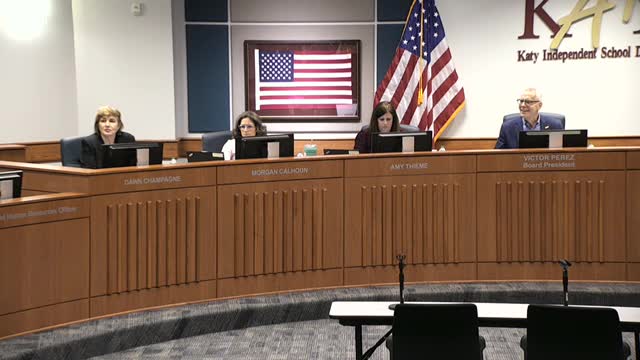
Katy Independent School District officials presented results Jan. 13 from a fall 2024 survey of the district’s third‑through‑twelfth grade one‑to‑one Chromebook program, saying students use the devices frequently but that recurring hardware and connectivity issues merit further attention.
“The Chromebook program ... was launched this past fall,” Andrea Grooms, the district communications lead who presented the results, told trustees. The program, she said, “emerged out of the Bond 2023 initiative in which the community approved Chromebooks, designed to provide a standardized and secure device to every third through twelfth grade student.”
Survey highlights - Participation: Grooms reported strong responses from elementary students (about 73% participation among that cohort), 53% participation for junior high students and 21% participation for high school students; overall response counts in the full reports were about 15,000 elementary student responses, about 11,000 junior high responses and roughly 6,500 high school responses. - Sentiment and use: Grooms said 81% of elementary students “strongly agreeing or agreeing” that they like their Chromebook and that it helps their learning; junior high students were at roughly 71% and high school students roughly 59% on similar sentiment measures. Reported daily use inside school was high in self‑reports: Grooms said elementary students and teachers reported daily use frequencies above 80% for classroom instruction, while junior high and high school teacher reports of daily classroom use were lower (about 48% and 40% respectively). - Problems and device comfort: Teachers and parents flagged battery life and Wi‑Fi connectivity as the most common problems. District staff reported the devices weigh between about 2.7 and 3.2 pounds; when asked whether the Chromebook was “comfortable to carry,” about 45% of elementary students indicated it was comfortable and an additional ~33% said it was sometimes comfortable. Grooms also noted that a substantial share of parents who reported their child had mentioned discomfort said the student described the Chromebook as uncomfortable to carry. - Logistics and costs: The district said the full technology package approved by Bond 2023 totaled about $83 million, with the one‑to‑one device procurement itself reported at roughly $16 million; district staff reported more than 74,000 Chromebooks had been distributed districtwide at the time of the presentation.
Trustee questions and staff follow‑up Trustees asked about notable discrepancies where students and parents reported higher daily use than junior high and high school teachers reported. Grooms said the district’s internal teams had just received the full disaggregated reports and would analyze the differences to see whether they reflected scheduling, perception differences, or survey sampling variation. Trustee Calhoun and others suggested targeted follow‑up surveys or sampling at specific high schools to improve representation among older students.
Other operational notes - The district said that many initial connectivity problems reflected the early phase of rollout and the need to rebalance school Wi‑Fi networks after tens of thousands of devices began connecting simultaneously. - Staff noted an established support system: when devices malfunction, the district can issue immediate hot‑swap replacements and log help‑desk tickets; long‑lead or replacement device purchases are subject to a five‑year life cycle and will be considered in future bond/replacement planning.
Why this matters Trustees and staff framed the survey as a baseline: the rollout supplied devices to students who previously lacked standardized hardware, but the data identify targeted operational fixes the district intends to prioritize (battery life, Wi‑Fi coverage, and device comfort/carrying solutions). The district also signaled willingness to re‑sample high school students if necessary to improve representativeness.
Ending note District staff said they will drill further into the full reports, which include more than 100 data points, and return to trustees with targeted actions to address high‑frequency issues raised by students, parents and teachers.