Get Full Government Meeting Transcripts, Videos, & Alerts Forever!
Get email alerts on the School Budget topic
No spam. Unsubscribe anytime.
North Andover committee hears three FY26 budget scenarios; guidance budget would trigger deep cuts
Summary
Interim Superintendent Pam Lathrop presented three FY26 budget scenarios Jan. 21 that range from a $71.8 million level‑service estimate to a town‑manager guidance figure that would require roughly $6.9 million in reductions; an alternative plan aims to limit harms by cutting about $4.18 million from level service.
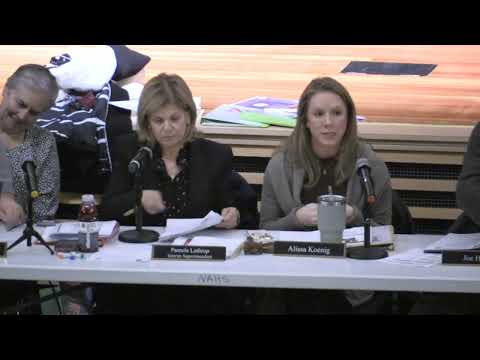
Interim Superintendent Pam Lathrop presented three scenarios for the North Andover Public Schools’ proposed fiscal 2026 budget at the Jan. 21 School Committee meeting: a level‑service budget of $71,784,091, a guidance budget aligned to the town manager’s allocation that creates a roughly $6,925,178 shortfall relative to level service, and an alternative plan that reduces the level‑service total by $4,179,129 to limit but not eliminate program and staff reductions.
The presentation matters because the guidance budget would force reductions across the district, Lathrop said, while the alternative would preserve more student‑facing staff and reserves. "The vast majority of our school's general fund is spent on salaries, approximately 83 percent," Lathrop said, summarizing why level service is much larger than some residents expect. She said the district also relied on one‑time federal ESSER funds that have expired and left recurring salary costs in the general fund.
Committee member John Moskovich framed the townwide context in a longer explanation of local tax limits and Proposition 2½, saying voters set a constraint that affects how much the town can raise without a ballot override. "Prop 2½ provided that total local taxes would grow every year at 2½ percent," Moskovich said, urging committee members to consider the town meeting path for any additional funding rather than a straight override vote.
Lathrop walked the committee through the specific operational impacts under the guidance and alternative scenarios. Under the guidance reductions she described: elimination of about 23 classroom teachers and 13 teaching assistants in preK–5; about 10.5 teachers and multiple support positions at the middle school; roughly 12 teachers and reductions to extracurricular programs at the high school; reductions in special‑education teaching assistants and the elimination of the district out‑of‑district tuition and transportation reserve. The guidance budget would also temporarily close Kittredge Elementary and reassign those students to Sargent Elementary, she said. Under the alternative budget the district would still reduce staff and services but in smaller amounts (for example, about 16 teachers rather than 23 at the elementary level) and would preserve the special‑education reserve that the guidance scenario removes.
Lathrop flagged major cost drivers included in her level‑service calculations: large forecasted increases in transportation, foster/homeless transportation, and special‑education tuition. She said special‑education out‑of‑district tuition projections are particularly volatile and contributed to the higher level‑service total. Assistant budget director Tracy McKellar described a timing issue that inflates the level‑service increase on paper: the district’s FY25 spending exceeded the FY25 budget in several lines (notably transportation), so a level‑service budget reflects current spending rather than the prior year budgeted amounts.
Committee members pressed on tradeoffs and strategy. Moskovich and other members discussed short‑term tactics for persuading the select board, finance committee and town meeting to approve a larger appropriation than the guidance amount; Moskovich said town meeting offers debate and could yield a higher result than a ballot override. Committee member Michael Brown asked whether the alternative budget was built "bottom up" from the committee’s directives; Lathrop said the alternative was designed to meet as many committee directives as possible while reducing the total by about $4.18 million.
During the public comment period dozens of parents, teachers, and other residents urged the committee to seek additional revenue rather than accept the guidance cuts. Speakers warned of long‑term consequences if the guidance reductions are implemented: larger K–12 class sizes, eliminated library professionals at secondary levels, fewer counselors and nurses, reduced athletics and extracurricular offerings, and potential increases in out‑of‑district special‑education placements if students’ needs cannot be met in‑district. Jillian Connolly, a Sargent Elementary counselor and parent, urged support for interim superintendent Lathrop and pleaded that the district "advocate for the best" for students. Several speakers noted that North Andover’s per‑pupil spending trails many comparator towns and urged the committee to press town leaders for more funding.
Committee members and Lathrop agreed to additional outreach to the town manager, the select board and the finance committee to explore whether the town can allocate more resources (Moskovich described a recent discussion about untapped tax capacity linked to new commercial revenue). The committee scheduled a public hearing on the FY26 budget for Thursday, Jan. 30, at the high school auditorium and a School Committee forum Feb. 1.
The committee did not take a formal vote on any FY26 budget figure at the Jan. 21 meeting. Members said they will continue deliberations, engage other town boards and seek public input ahead of the statutory decision points and of town meeting.
Public comments and committee discussion repeatedly emphasized three tradeoffs: (1) accept the town manager guidance and enact large cuts that the administration says would materially change services and staffing; (2) ask the town for more revenue (via town meeting coordination or an override) to approach the level‑service plan; or (3) adopt the alternative budget to reduce but not eliminate key services and reserves. Residents and teachers at the meeting urged the committee to prioritize student supports and to campaign for additional town funding if needed. Ending: The committee will continue budget deliberations at the Jan. 30 meeting and pursue inter‑board discussions about whether the town can provide funding above the manager’s guidance.