Get Full Government Meeting Transcripts, Videos, & Alerts Forever!
Get email alerts on the Public Safety Fire topic
No spam. Unsubscribe anytime.
Committee increases fire‑suppression loan authority, removes contingencies and approves aviation funding
Summary
Joint Appropriations approved changes to the Emergency Fire Suppression account, including converting a proposed $10 million appropriation to loan authority, removing contingency exhaustion requirements, and later adding $5.5 million biennial funding for aircraft and staffing after reopening the unit.
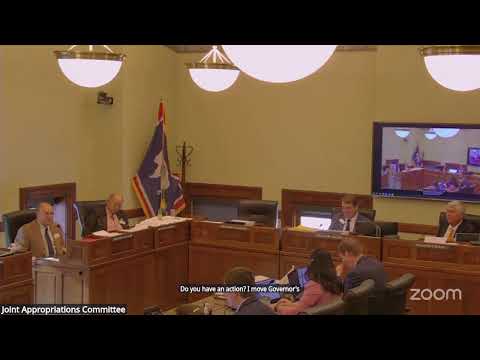
The Joint Appropriations Committee took several actions on the Emergency Fire Suppression account (Agency 060, Unit 0301), including approving increased loan authority, removing preconditions the governor had proposed, and adding new aviation and staffing funding.
Budget staff told the committee that the $10 million requested in the book should be treated as loan authority rather than an appropriation. Committee members approved removing the governor’s requirement that other contingency sources be exhausted (Homeland Security Disaster Contingency, Governor’s Office special contingency, and available OSLI funds) and approved $10 million in loan authority rather than an appropriation. The committee also approved the governor’s recommended appropriations earlier in the unit (two $20 million entries that were moved in committee action).
After the unit was initially closed, Senator Driscoll asked to reopen the unit and moved to add $5,500,000 for the biennium to fund an additional single engine air tanker (SEAT)/helicopter capacity and associated staffing. Senator Driscoll described the funding as a cost‑effective investment that could prevent much larger suppression costs. Committee discussion clarified staffing and costing assumptions: Mr. Richards restated the sponsor’s motion as 2,750,000 per year biannualized (5,500,000 per biennium) and noted the request included five FTEs total — one full‑time and four seasonal positions — and asked staff to confirm the mix of contract aircraft and staffing. Testimony in the hearing referenced a Type‑3 helicopter at about $750,000 and contracted single‑engine air tanker teams at approximately $1,200,000 per contracted asset.
The committee voted to adopt the amendment adding the aviation funding. Subsequent roll calls on the unit as amended recorded 11 ayes and 1 excused.