Get Full Government Meeting Transcripts, Videos, & Alerts Forever!
Get email alerts on the Government:tax Administration topic
No spam. Unsubscribe anytime.
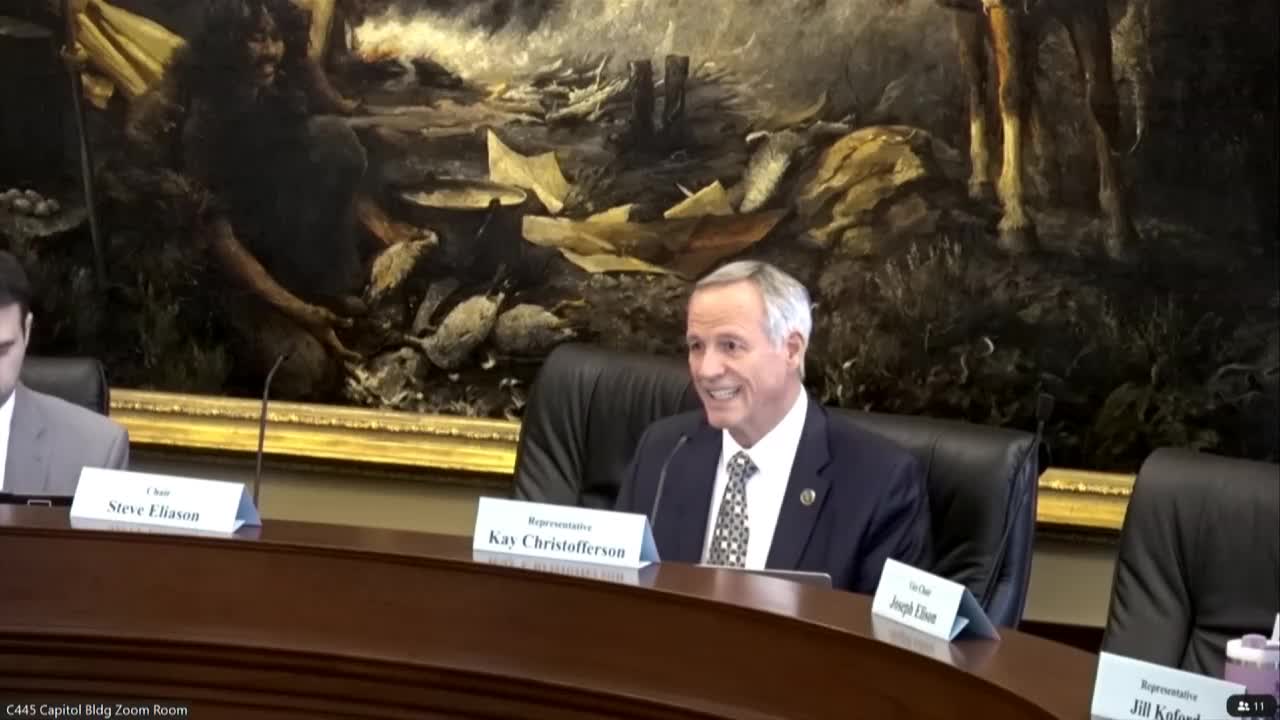
Committee approves technical fixes to Tax Commission structure, shifts appointment authority to executive director
Summary
HB 259 cleared the House Revenue and Taxation Committee unanimously after sponsors and Utah State Tax Commission leadership said the bill preserves a conflict-of-interest wall between operations and appeals by clarifying appointment authority and adjusting executive director compensation.
The House Revenue and Taxation Committee unanimously passed House Bill 259 after hearing testimony from John Valentine, chair of the Utah State Tax Commission, who described the measure as a technical correction to preserve operational-adjudicative separation inside the agency.
Valentine told the committee the Utah State Tax Commission is established in the Utah Constitution and that statutes and internal rules provide a firewall between the commission’s adjudicative functions and the agency’s operational side. "We do not have communication that occurs back and forth between the operation side and the adjudicative side, except for in the courtroom," Valentine said, explaining the commission’s intent to keep appeals independent from agency audit and enforcement work.
The bill clarifies that certain administrators — including the motor vehicle enforcement administrator — should be appointed by and report to the executive director rather than directly to the commission, addressing a statutory language gap that the commission said breaches the conflicts wall. Valentine said the change is consistent with the 2023 reorganization that separated operational functions from adjudicative duties.
The second change in HB 259 adjusts statutory compensation: it replaces the agency-provided motor vehicle car benefit and sets the executive director’s base pay nearer to that of an associate commissioner. Committee members asked about a modest fiscal note; Valentine said the fiscal impact — about $17,000 — represents the differential between providing a state vehicle and the proposed salary adjustment.
After brief public comment and questions, committee members adopted a motion to pass HB 259 with a favorable recommendation; the committee recorded unanimous aye votes.
The changes are administrative and designed to maintain separation between the Tax Commission’s operational staff (who handle audits, collections and DMV enforcement) and its adjudicative panels and commissioners, according to committee testimony. The bill does not change the commission’s constitutional status or create new enforcement authorities; it clarifies internal appointment and compensation language to match executive management practice.