Get Full Government Meeting Transcripts, Videos, & Alerts Forever!
Get email alerts on the Jurisdiction topic
No spam. Unsubscribe anytime.
Committee approves bill to allow concurrent juvenile jurisdiction on Indiana military property
Summary
House Bill 1121, which would enable Indiana to establish concurrent jurisdiction with the federal government for juvenile delinquency matters on certain military properties, passed the committee after Department of Defense testimony; committee roll call recorded 130 yes votes.
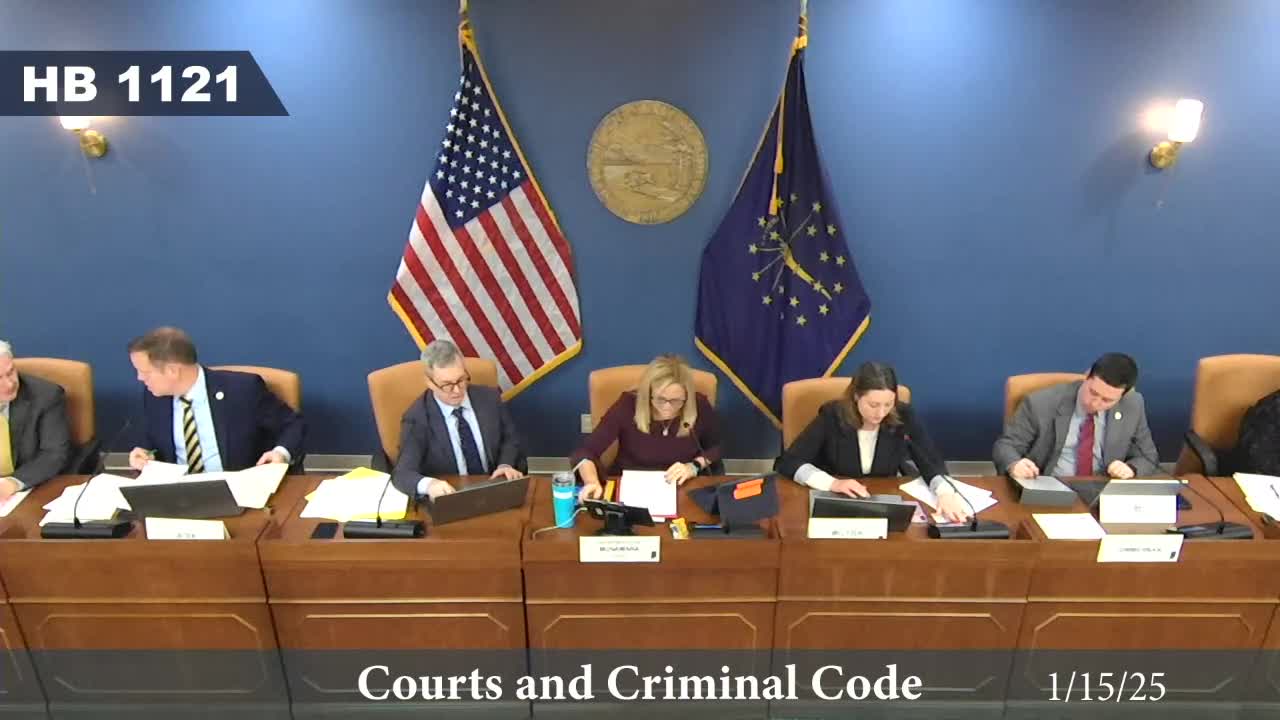
The House Courts and Criminal Code Committee voted to pass House Bill 1121, which creates a procedure for the state to establish concurrent jurisdiction with the United States for juvenile delinquency proceedings on military property located in Indiana.
Representative Wendy McNamara, sponsor, said the bill responds to situations on federal military installations where juvenile misconduct can currently only be adjudicated in federal courts and the federal system has limited juvenile-specific disposition options. The bill was described as narrow in scope; an amendment limited the measure to delinquency acts rather than other juvenile matters.
Shane Preston, Great Lakes regional liaison for the U.S. Department of Defense State Liaison Office, testified in support and described instances in other states where exclusive federal jurisdiction left a “black hole” for juvenile adjudication. “House bill 1121 is key to appropriately addressing and reducing juvenile conduct on military installations,” Preston said, adding that concurrent jurisdiction enables state juvenile courts to provide alternative dispositions and wraparound services not available under some federal procedures.
Committee members questioned filing mechanics when a military property spans multiple counties; the chair offered and obtained a chairman’s amendment to require recording the jurisdictional agreement in the office of each county where the property is located. After amendments, the committee voted to pass the bill; the transcript records a roll-call result of 130 yes.
Supporters said the bill follows an approach used in other states and would permit state juvenile courts to adjudicate delinquency on areas of military property where the federal government agrees to concurrent jurisdiction. The committee recorded no opposing testimony during the hearing.