Get Full Government Meeting Transcripts, Videos, & Alerts Forever!
Get email alerts on the Low Water Crossings topic
No spam. Unsubscribe anytime.
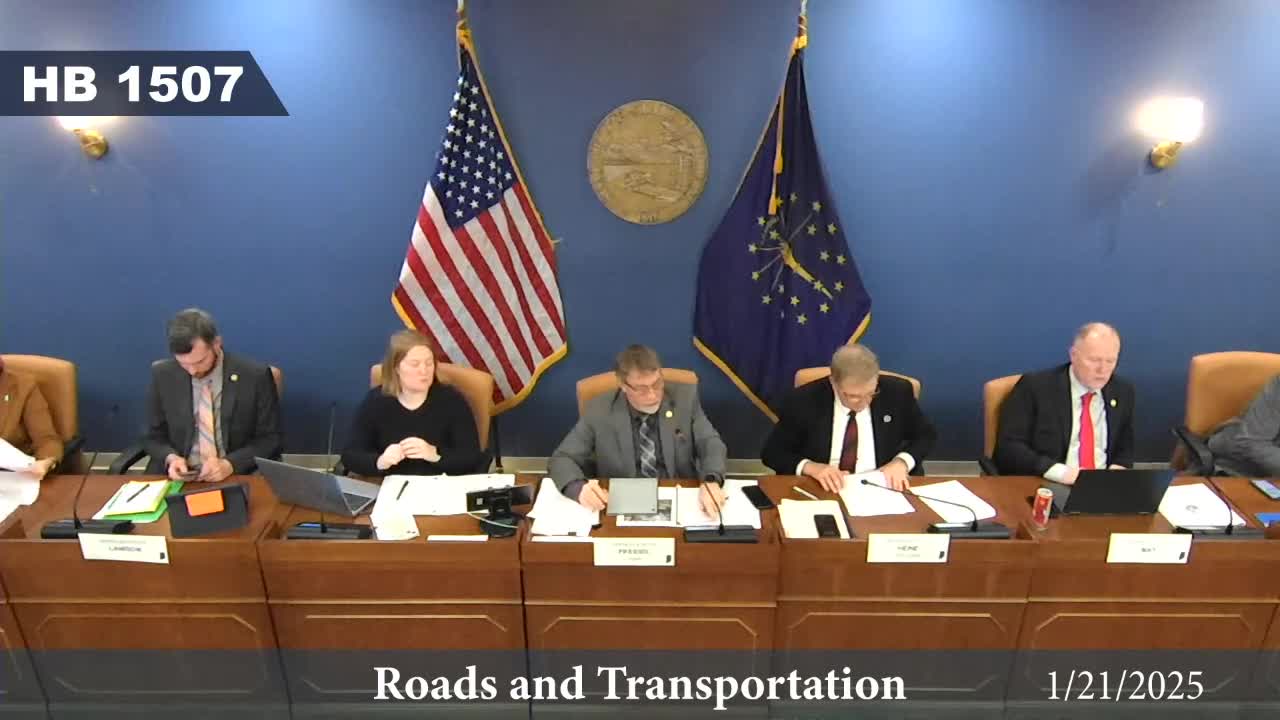
Committee advances House Bill 1507 after testimony on low-water crossings and local safety impacts; passes 11-0
Summary
House Bill 1507, which would define “low water crossing” in state code, allow county plans and open grant eligibility for replacement or mitigation, passed the Roads and Transportation committee 11–0 on Jan. 21 after testimony describing local fatalities and infrastructure shortfalls.
The Roads and Transportation Committee voted unanimously to advance House Bill 1507 on Jan. 21 after lawmakers heard testimony about the safety and funding gaps posed by low water crossings in rural Indiana.
The bill would add a statutory definition of “low water crossing” and authorize county commissioners to assemble local road-and-bridge boards to develop plans that could include new signage, warning lights, culvert replacement, or full bridge replacement. Lawmakers said the definition will also allow those structures to qualify for state grants that currently require an express statutory category.
“Low water crossings obviously do not meet road standards as they are written today,” Representative Patterson, the bill author, told the committee, noting Franklin County has “at least 30 identified low water crossings.” Patterson said the lack of a statutory definition prevents counties from accessing certain grant programs and forces counties to shoulder replacement costs.
Testimony included two written accounts read into the record describing deaths in Franklin County after drivers attempted to cross a concrete slab during high water. Carol Zins Rowell described losing her 4-year-old nephew in the 1988 incident; Mary Zinsbergman’s testimony recounted the same crash and its long-term family impact. Jaren Jackson also testified about the death of a community member at a low water crossing and urged passage to prevent further tragedies.
Local government support came from Ryan Hoff of the Association of Indiana Counties, who said clarifying statutory authority would permit counties to use several existing funds — including community crossings and cumulative bridge funds — for these small-structure projects. Hoff told the committee the bill also clarifies a population split for community crossings eligibility.
Committee members asked technical questions about which local units (counties or towns) would be eligible for funds and whether cumulative bridge funds could be used; Hoff said many counties already use bridge funds for small structures, and the committee signaled intent to clarify eligibility in follow-up language.
The committee moved to pass the bill and recorded an 11–0 vote in favor (two members excused). The roll call recorded the following: Pressell — Aye; McNamara — Yes; Lindauer — Yes; Dan Chester — Yes; Haggard — Excused; Hamilton — Yes; Harris — Excused; May — Yes; Andrade — Yes; Heine — Aye; Patterson — Aye; Soliday — Aye; Lawson — Yes. The chair announced “Bill passes 11 to 0.”
Why it matters: Supporters said the statutory definition will unlock grant eligibility and create a clear local planning path for structures that are seasonal hazards, result in school closings and emergency-service delays during heavy rain, and have been linked to past fatalities.
What’s next: Committee members indicated they will clarify technical funding language in subsequent amendments; the measure advanced to the next legislative stage with unanimous committee support.