Get Full Government Meeting Transcripts, Videos, & Alerts Forever!
Get email alerts on the Low Water Crossings topic
No spam. Unsubscribe anytime.
Panel approves bill defining low-water crossings, opening grant eligibility after emotional testimony
Summary
House Bill 1507 would define 'low water crossing' in Indiana code, allow counties to form local road-and-bridge boards to plan mitigations and make such crossings eligible for certain grants. The committee voted 11–0 to pass the bill after multiple residents recounted fatal incidents at such sites in Franklin County.
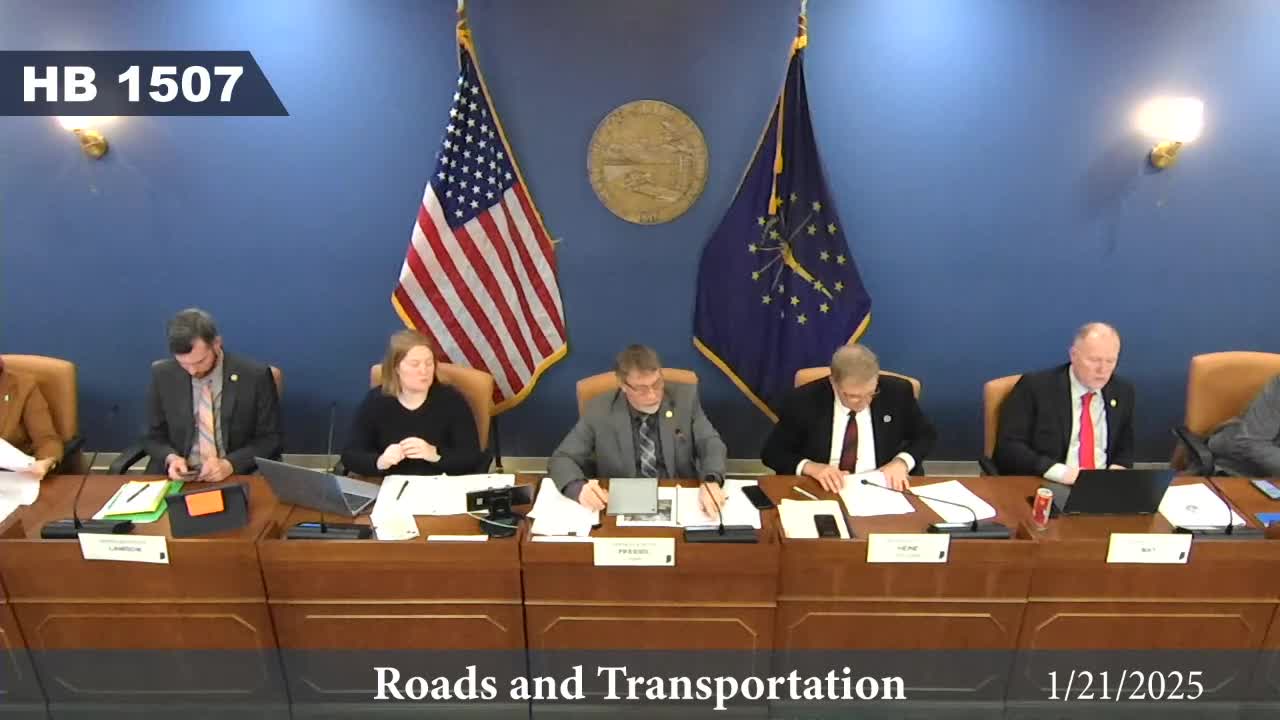
A unanimous committee vote Wednesday sent House Bill 1507 out of the Roads and Transportation Committee after lawmakers adopted a motion to pass the bill following emotional public testimony.
The bill would add a statutory definition of a "low water crossing," allow county commissioners to assemble local road-and-bridge boards to develop mitigation plans, and make low water crossings eligible for grant programs that currently exclude them. Representative Patterson, sponsor of the bill, told the committee the measure is aimed at enabling signage, flashing lights, culvert replacement or full bridge replacement where appropriate.
Why it matters: counties and witnesses said the absence of a statutory definition leaves low water crossings ineligible for some state funding streams. "Without proper definition in code, they do not fall under a category for state grants or funding," Patterson said during her presentation. Witnesses and county officials said low water crossings cause school cancellations, delivery interruptions, delayed emergency response and, in some cases, fatalities.
Testimony and local impact: Representative Patterson read written testimony from Franklin County residents who described tragic accidents. Carol Zins Rowell recounted the 1988 deaths of her 4-year-old nephew and the vehicle’s babysitter after a flooded slab swept their car away. Mary Zinsbergman’s written testimony provided a contemporaneous account of the same crash and urged passage of the bill to prevent similar losses.
Ryan Hoff of the Association of Indiana Counties testified in support, saying the language clarifies use of several county funding sources for structures that fall into a gray area under current law. "This language clarifies the ability of counties to use various funds for this type of structure that kind of falls into a gray area currently in statute," Hoff said.
Committee action: after discussion, a member moved to pass the bill and the committee agreed on a roll call that recorded 11 yes votes; two members were excused. The clerk announced: "Bill passes 11 to 0."
What’s next: the bill now advances from committee. Supporters said it will allow counties to seek funding for replacements or upgrades that improve motorist safety and keep freight and emergency services moving.
Quotes: "Low water crossings are dangerous and can be confusing as to how deep the water is," testimony read by Representative Patterson said in support of the bill. "Please consider how important it is to proceed with House Bill 1507," the written testimony from Carol Zins Rowell concluded.
Additional details: Representative Patterson said Franklin County has identified at least 30 low water crossings; she distributed a photo packet to committee members showing local examples. County officials asked for clarification that existing county bridge or cumulative bridge funds could be used where appropriate; Ryan Hoff said several counties already use bridge funds for small structures and the bill would clarify funding eligibility.