Get Full Government Meeting Transcripts, Videos, & Alerts Forever!
Get email alerts on the Municipal Judiciary Residency topic
No spam. Unsubscribe anytime.
Committee advances constitutional amendment to expand residency pool for town and city court judges
Summary
The committee voted to pass HJ1, a proposed constitutional amendment that would expand residency eligibility for town and city court judges to include attorneys in the county or an adjacent county; the measure passed the committee by voice vote and recorded consensus of 130 yes votes.
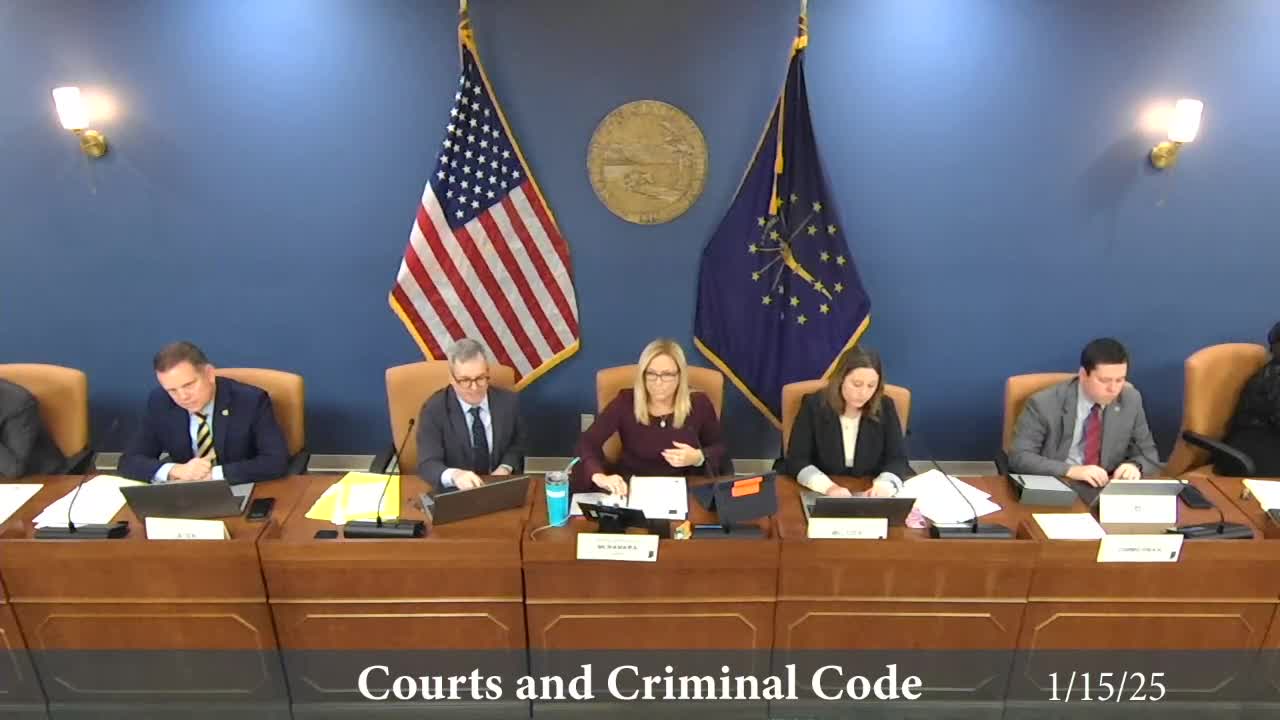
Representative Aylesworth presented HJ1 to the House Courts and Criminal Code Committee on Wednesday, asking the panel to advance a constitutional amendment that would expand the residency requirement for town and city court judges so attorneys from the county or a neighboring county are eligible to serve.
Aylesworth said the current state constitutional residency rule requires judges to reside in the municipality, a restriction that has created difficulty filling town and city court vacancies in smaller communities. “In small town America changing demographics have changed the amount of attorneys that are available to do the job in small towns,” Aylesworth said, describing an example in northern Lake County where a vacancy required a Supreme Court appointment and an appointed judge to change residency to serve.
The amendment would alter the state constitution’s residency language to permit attorneys from the county where the municipality sits or an adjacent county to be eligible for town and city court judgeships. Aylesworth said she discussed the proposal with Supreme Court judicial staff, who encouraged the change. She told the committee there are 52 town and city courts in Indiana and asked for members’ support.
No witnesses signed up to testify. The committee moved the measure and recorded unanimous/housewide support in committee, with a final roll-call reading captured at “Passes 130.” The committee record shows the motion carried and the bill advanced as required by the constitutional amendment process; Aylesworth noted additional legislative steps next year will be required to place the amendment on the ballot for voter referendum.
The amendment, if adopted by the General Assembly in separate sessions as required by the state constitution, would be placed on the ballot for voters to approve or reject in a future referendum, a multi-step process Aylesworth summarized for the committee.