Get Full Government Meeting Transcripts, Videos, & Alerts Forever!
Get email alerts on the State Board Budget topic
No spam. Unsubscribe anytime.
State Board of Education seeks new staff, IT and one-time workforce grants in FY2026 budget
Summary
The Office of the State Board of Education presented a FY2026 request that would expand personnel, fund IT and school-safety functions moved into the office, and includes Governor Little’s $15 million one-time workforce capacity grant; lawmakers pressed officials on centralization, Independent Study Idaho and fee funding.
The Office of the State Board of Education asked the Joint Finance‑Appropriations Committee on Thursday for funding and staff increases tied to new responsibilities moved into the office and several program enhancements, including a $15 million, one‑time public workforce capacity grant proposed by the governor.
The request covers three divisions — OSB Administration, IT and Data Management, and the School Safety and Security Program — and reflects recent transfers of programs and positions from other state entities. Lawmakers pressed Executive Director Joshua Whitworth and department staff about the pace of centralization, the role of user fees versus appropriations, and whether some requests require legislation.
Kevin Campbell, a Budget and Policy Analyst with the Legislative Services Office, reviewed base and historical budgets for the Office. He told the committee the three divisions’ base budgets total roughly $55.3 million across personnel and operating lines (OSB Administration: $45,100,000 and 49.75 FTE; IT and Data Management: $8,900,000 and 27 FTE; School Safety and Security: $1,300,000 and 7.5 FTE) and that OSB currently has 84.25 authorized FTE with eight vacancies. Campbell also noted the budget’s federal COVID and ARPA inflows have made multi‑year comparisons uneven and highlighted the $30 million Empowering Parents appropriation enacted for FY2024.
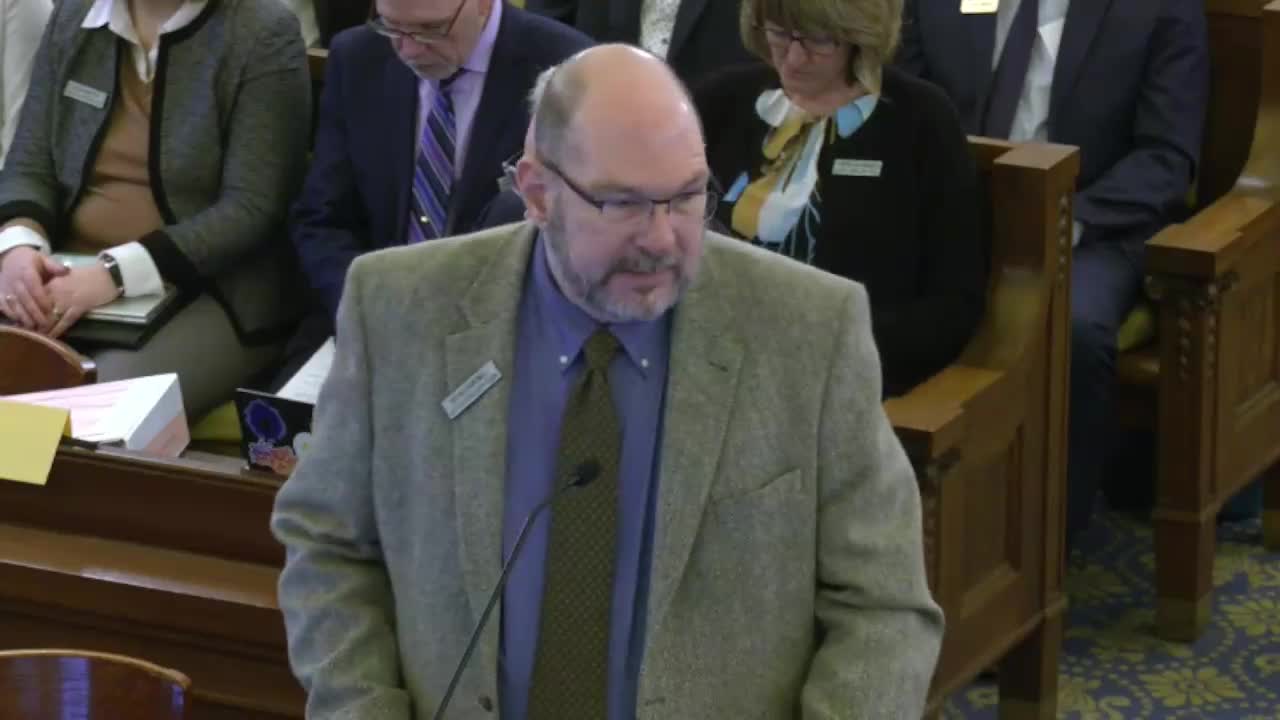
Whitworth, the OSB executive director, said centralizing functions — including internal audit, risk management and IT — was intended to reduce silos and produce systemwide efficiencies. "One of the primary motives of the board's directive is to look at systemness," Whitworth told the committee, using the board’s shorthand for coordinating services and reducing duplicated effort.
But lawmakers raised concerns about growth in centralized staff and whether transferring positions to the board produced corresponding reductions elsewhere. Representative Petzke asked why centralization was increasing authorized FTE from about 60 to more than 80. Whitworth said many transfers were net zero — positions moved into the Office from institutions or other agencies — and pointed to added responsibilities such as school safety and IT support for roughly 300,000 students.
Lawmakers also asked about specific requests in the FY2026 packet. Campbell and Whitworth described the governor’s public workforce capacity grant as a one‑time $15,000,000 program that would match private fundraising at different ratios depending on the institution (1:1 for Boise State, Idaho State and the University of Idaho; 1:2 for Lewis‑Clark State College and the community colleges). Whitworth said eligible projects would target in‑demand workforce programs identified by technical advisory and business advisory committees and the Workforce Development Council, citing fields such as welding, fabrication, mechatronics and certain energy‑sector trades.
Independent Study Idaho drew sustained questioning from lawmakers who said the program serves a small number of students yet relies mostly on fees. Whitworth described it as a flexible delivery option that lets nontraditional students take courses at their own pace and said the program charges about $160 per credit. He and Campbell said the current fee‑reliant model produces funding volatility — for example, when students fail a course the fees remain in the program rather than going to institutions — and asked the committee to consider whether a base appropriation or other structural change is warranted.
On information technology, several senators and representatives asked whether proposed full‑time IT positions would replace contractors and whether the state had reached a tipping point where hiring permanent staff would be cheaper and more effective. Whitworth said contractors currently fill many roles; hiring a database engineer and systems/infrastructure engineer would reduce long‑term contracting costs and give the Office more capacity to maintain core applications.
Several lawmakers also pressed for follow‑up materials. Senator Cook asked for details on contractor expenditures, the IT maintenance backlog and measurable outcomes for enhancement requests. Representative Tanner and others asked the Office to provide documentation showing which FY2026 requests require statutory change; Whitworth confirmed the behavioral threat assessment team request requires legislation and already had a sponsor.
Multiple legislators raised the policy issue commonly labeled DEI (diversity, equity and inclusion). Whitworth and committee members clarified that services and centers focused on historically marginalized communities are funded mainly by student fees and that the board has adopted changes in response to legislative direction; Whitworth and other speakers said most of those services are not supported by general fund appropriations.
The committee did not take votes on OSB items during the hearing. Staff and the Office agreed to provide more detailed information — including the IT plan, contractor expenditures, lists of eligible programs for the workforce grant, and a clearer breakdown of transfers — to inform work‑group review and potential budget actions.
Funding requests and program transfers discussed by the committee will return to the work group and the full committee for decision votes later in the session.