Get email alerts on the Special Education Open Enrollment topic
No spam. Unsubscribe anytime.
Board adopts special-education open-enrollment caps using workload model
Summary
The Mosinee School Board approved open-enrollment space caps for special education after a staff presentation explaining a DPI‑recommended workload approach that converts student needs to seat counts.
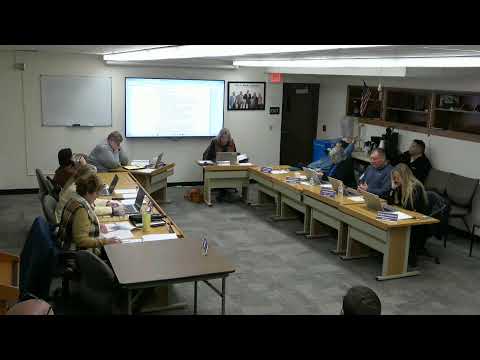
The Mosinee School Board on Jan. 20 approved its annual open‑enrollment space availability resolution for special education, adopting seat caps based on a workload model staff said aligns with new Wisconsin Department of Public Instruction guidance.
Brian, the district staff member who presented the projections, told trustees the district moved from a traditional caseload model to a workload approach that assigns points for academics, health/safety and family communication and converts totals into seat values. "The biggest thing is we want to make sure we have the space to actually service IEPs," Brian said, describing the methodology used to keep services manageable and legally compliant.
Under the recommendation approved by the board, staff instructed the district to set the following openings for the coming year: 28 cross‑categorical seats at the elementary level, 2 elementary self‑contained seats, 5 early‑childhood seats, 10 cross‑categorical middle‑school seats, 3 middle‑school self‑contained seats, and 5 high‑school self‑contained seats. Staff also recommended speech‑and‑language availability of 22 early‑childhood, 16 elementary and 10 middle‑school seats. The board approved the motion as presented.
Brian explained that contracted services (for example, vision impairment, deaf/hard‑of‑hearing, certain therapists) are treated as unavailable for open enrollment because the district does not have in‑house staff for those programs. He also explained the local workload tool: students scored as "minimal" or "moderate" count as one seat, "extensive" counts as two, and "comprehensive" counts as three, a method the presenter said is being used by neighboring districts.
"Last year DPI moved away from a caseload approach... they said that's a local control thing," Brian said, explaining why the district developed a standard local calculation and completed workload forms for each student before winter break.
The board voted to approve the recommended numbers; the motion was moved and seconded during the meeting and carried.
AI generated
The text on this page is AI generated. Summaries, highlights, analysis, and video transcripts are all produced from the original source material.
AI can make mistakes, so if you spot one, and we will fix it for everyone.
Note: the source content is unaltered by us. Any content source we link to, be it a video, an audio recording, or a document, is presented exactly as its publisher released it. That publisher is usually a government body, sometimes an individual official or another organisation.