Get Full Government Meeting Transcripts, Videos, & Alerts Forever!
University of Minnesota briefs Senate jobs committee on AI's economic potential, workforce and risk
Summary
University of Minnesota researchers told the Senate Committee on Jobs and Economic Development on Jan. 22 that artificial intelligence could add billions to Minnesota's economy, especially in medtech, agriculture and manufacturing, while urging investments in data infrastructure, workforce training and safeguards against misuse.
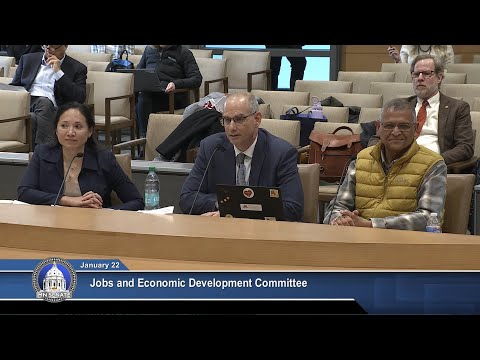
The University of Minnesota’s data science and artificial intelligence team told the Minnesota Senate Committee on Jobs and Economic Development on Jan. 22 that AI could deliver large economic gains for the state but requires coordinated investment in computing infrastructure, workforce training and responsible-use safeguards.
The briefing, given to the panel chaired by Senator Champion, laid out opportunities in medical technology, agriculture and manufacturing and warned of potential harms if data quality, governance and oversight are not addressed.
“AI systems are accelerating drug discovery, accelerating the development of new materials, accelerating scientific research, improving energy efficiency, and making education more accessible and personalized,” said Galen Jones, professor of statistics and director of the School of Statistics at the University of Minnesota. Jones told the committee that Minnesota is well positioned because of its research base, medtech cluster and existing innovation networks.
The presenters — including Vipin Kumar, regents professor of computer science; Genevieve Meltemieux, professor of surgery and health informatics; James (Jim) Wilgenbusch, director of the Minnesota Supercomputing Institute; Haley Bourke, managing director of the Data Science and AI Initiative; and Jaydeep Srivastava, professor of computer science and engineering — described both economic projections and practical constraints.
Why it matters: Committee members heard concrete estimates and sector-level examples that could shape future state policy. University presenters cited outside projections and state-level data to argue Minnesota can capture AI-driven…
Already have an account? Log in
Subscribe to keep reading
Unlock the rest of this article — and every article on Citizen Portal.
- Unlimited articles
- AI-powered breakdowns of topics, speakers, decisions, and budgets
- Instant alerts when your location has a new meeting
- Follow topics and more locations
- 1,000 AI Insights / month, plus AI Chat