Get Full Government Meeting Transcripts, Videos, & Alerts Forever!
Get email alerts on the Jobs And Economic Development Ai topic
No spam. Unsubscribe anytime.
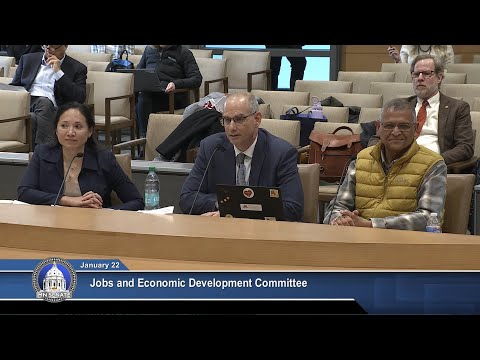
University of Minnesota briefs Senate jobs committee on AI's economic potential, workforce and risk
Summary
University of Minnesota researchers told the Senate Committee on Jobs and Economic Development on Jan. 22 that artificial intelligence could add billions to Minnesota's economy, especially in medtech, agriculture and manufacturing, while urging investments in data infrastructure, workforce training and safeguards against misuse.
The University of Minnesota’s data science and artificial intelligence team told the Minnesota Senate Committee on Jobs and Economic Development on Jan. 22 that AI could deliver large economic gains for the state but requires coordinated investment in computing infrastructure, workforce training and responsible-use safeguards.
The briefing, given to the panel chaired by Senator Champion, laid out opportunities in medical technology, agriculture and manufacturing and warned of potential harms if data quality, governance and oversight are not addressed.
“AI systems are accelerating drug discovery, accelerating the development of new materials, accelerating scientific research, improving energy efficiency, and making education more accessible and personalized,” said Galen Jones, professor of statistics and director of the School of Statistics at the University of Minnesota. Jones told the committee that Minnesota is well positioned because of its research base, medtech cluster and existing innovation networks.
The presenters — including Vipin Kumar, regents professor of computer science; Genevieve Meltemieux, professor of surgery and health informatics; James (Jim) Wilgenbusch, director of the Minnesota Supercomputing Institute; Haley Bourke, managing director of the Data Science and AI Initiative; and Jaydeep Srivastava, professor of computer science and engineering — described both economic projections and practical constraints.
Why it matters: Committee members heard concrete estimates and sector-level examples that could shape future state policy. University presenters cited outside projections and state-level data to argue Minnesota can capture AI-driven growth but must act on infrastructure and workforce preparation to do so.
Key details and estimates - University presenters cited a PricewaterhouseCoopers projection that AI could add about $15.7 trillion to the global economy over the next five years. The presenters said Minnesota could see substantial benefits in medtech, agriculture and manufacturing. - The University testimony included state-specific estimates: smart medtech could add roughly $40 billion to Minnesota’s GDP if the state fully captures expected growth in that sector; manufacturing-related AI advances were estimated to add about $1.1 billion by 2033. The presenters cited a $1.5 billion global AI-and-agriculture market projected to double by 2026. - University of Minnesota assets named as state advantages included large research datasets (Minnesota Population Center, Polar Geospatial Center, the Center for Magnetic Resonance Research), the Data Science and AI Initiative and a highly ranked master’s program in data science.
Sectors highlighted - Medical technology: Genevieve Meltemieux said AI can shift care from reactive to proactive and support personalized interventions, remote services and accelerated drug discovery. She urged better data aggregation across providers and shared incentives for industry, payers and health systems to accelerate “smart medtech.” - Agriculture and food: Galen Jones and other presenters described precision farming, real-time water-quality prediction, climate-resistant seed development and supply-chain optimization as areas where AI can increase productivity and reduce waste. - Manufacturing and materials: Presenters said AI-driven smart manufacturing, advanced robotics, new materials and energy-efficiency improvements can boost Minnesota’s existing manufacturing base, currently described as about 13% of state GDP (roughly $58 billion annually).
Infrastructure and data centers Committee members asked about data center siting, power and water. James Wilgenbusch described the university’s own data center effort to retain and govern data locally and said proximity, governance and renewable power sources matter. Presenters noted computing’s rising energy share — roughly 2% of electricity five years ago and about 6% today — and warned generative AI could dramatically increase demand without planning.
Workforce and education Presenters recommended a broad, K–20 and continuing-education strategy to build AI and data literacy, upskill current workers and expand pathways into AI-related jobs. Haley Bourke emphasized public-private partnerships and workforce development programs to place Minnesotans into new roles created by AI.
Risks, governance and safeguards University speakers repeatedly stressed responsible AI, transparency and human oversight. Vipin Kumar said generative AI “does not know what it does not know” and can produce confident but incorrect outputs; Genevieve Meltemieux emphasized life-and-death stakes in health care. Presenters recommended governance boards, transparency practices, and state guidance for corporate and public-sector AI deployment.
Federal and interstate context Presenters pointed to other states’ investments — Wisconsin ($32 million), New York’s Empire AI initiative ($400 million), Florida’s $100 million AI university effort — and to a recently announced large federal computing initiative (referred to in testimony as “Stargate” and described as a multi-hundred-billion-dollar federal effort) as factors that will influence Minnesota’s competitiveness.
What the committee heard about next steps Presenters urged the committee to consider mechanisms to coordinate AI efforts statewide, including investments in: (1) data infrastructure and governance; (2) supercomputing and data-center siting that account for energy and water; and (3) education and upskilling from K–12 through continuing education. They also offered to share research, convene technical briefings and provide state policymakers with policy references and examples from other jurisdictions.
Quotes from the hearing - “We must continue to be innovators to take advantage and realize these benefits,” Galen Jones said of Minnesota’s position in AI research and industry partnerships. - “This technology is at the intersection. It’s not a stand-alone technology that somehow just dropped from the sky,” Vipin Kumar said, describing the convergence of computing, data and algorithms. - “We’re never going to completely get the human out of the loop,” Genevieve Meltemieux said when discussing hallucinations and clinical risk in generative systems. - “Proximity still matters, with some of that, but also governance around that data is critical,” James Wilgenbusch said about data-center location and data control.
Ending The committee adjourned after roughly 90 minutes of presentations and questions and scheduled follow-up work, including a Jan. 27 meeting on demographic and workforce matters. Presenters said they would share additional materials, suggested policies and examples of safeguards for the committee’s consideration.