Get Full Government Meeting Transcripts, Videos, & Alerts Forever!
Committee hears overview of Minnesota school funding formulas, wide district disparities and special-education cost pressures
Summary
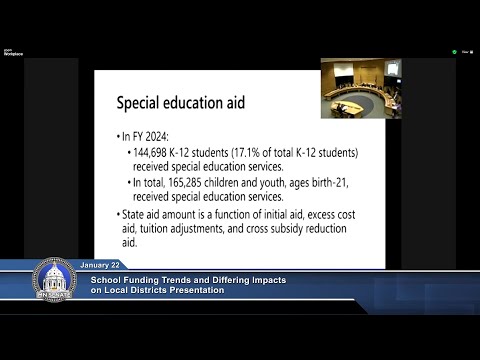
Nonpartisan staff reviewed how state, local and federal revenues and equalization work in Minnesota school finance, highlighting large variation among districts and a persistent special-education "cross subsidy" that draws on general funds.
Members of the Senate Education Finance Committee heard a nonpartisan briefing on school funding formulas and district revenue variation, and discussed how special-education costs are straining local general funds.
"Do a brief overview of the funding formulas. We get a lot of bills and discussions here in this committee," said Senator Rehrig, opening the request for the briefing and asking staff to clarify why district revenues vary. The committee invited nonpartisan staff to present an updated, district-level view of revenue sources and trends.
The presentation by Bjorn Arneson, a member of the nonpartisan Senate Council Research and Fiscal Analysis staff, summarized how district revenues are composed of federal aid, state aid and local property-tax receipts; how two different tax bases (referendum market value and net tax capacity, including adjusted net tax capacity or ANTC) are used across programs; and how equalization aid changes the share paid by the state versus local taxpayers. "My name is Bjorn Arneson. I'm a member of the nonpartisan, senate council research and fiscal analysis staff," Arneson told the committee before reviewing the data.
Why it matters: Arneson said the distribution of revenue matters because it affects both the total money available to districts and the tax effort required of local property owners. He showed statewide shares for fiscal 2025 in which roughly two-thirds of district revenues came from state sources, about one-quarter from local sources and roughly 8% from federal sources. Arneson advised members that some long-running legislative changes (including a major 2003 shift that moved a statewide property levy into state aid) have changed the mix of state and local funding.
Key findings and figures presented - General…
Already have an account? Log in
Subscribe to keep reading
Unlock the rest of this article — and every article on Citizen Portal.
- Unlimited articles
- AI-powered breakdowns of topics, speakers, decisions, and budgets
- Instant alerts when your location has a new meeting
- Follow topics and more locations
- 1,000 AI Insights / month, plus AI Chat