Get Full Government Meeting Transcripts, Videos, & Alerts Forever!
Get email alerts on the Capital Program Finance topic
No spam. Unsubscribe anytime.
Commissioners press staff on tied-up CIP money and procurement bottlenecks as $49 million in bond authority sits unsold
Summary
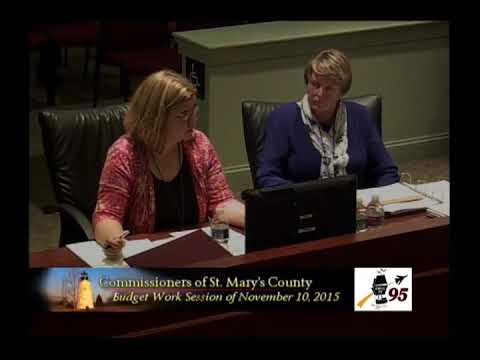
At a Nov. 10 St. Mary's County budget work session, officials reviewed unspent capital project balances and procurement schedules. Commissioners questioned why approved bond-authorized projects remain largely unspent and pressed staff on how to accelerate work or reprogram funds.
St. Mary's County commissioners pressed county finance and CIP staff on Nov. 10 about large unexpended balances in the capital improvement program and why roughly $49 million in bond authority remains unsold.
The discussion centered on the county's project-level unexpended balances and how funding sources are applied as projects advance. Patty Stigman, deputy director of finance, told the board that the schedule of unexpended balances on pages 1'2 is "updated through October 30th" and described the ledger columns showing encumbrances and total balances by funding source.
Commissioners said the appearance of large balances tied to bond authority creates pressure to either accelerate projects or reprogram the money to higher-priority needs. Staff described the routine they use to apply the most-restricted funding sources first (for example, impact fees and state/federal grants) and to preserve flexibility by applying county PAYGO last. That accounting, Stigman said, is why some amounts show as "bonds not sold" on the ledger even when a project is budgeted for bond funding.
Procurement capacity emerged as a second theme. Randy Burns, procurement manager, described an internal project procurement schedule his office compiles each year to time solicitations and avoid bottlenecks. He said the office had reduced backlog compared with prior years but cautioned that complex projects and grantor requirements can delay solicitations. "We will not go forward with a solicitation unless 100% of the funding is in place," Burns told the board, saying that policy protects taxpayers from partially funded contract awards and potential contract cancellations.
Board members asked for measures that would shrink the pipeline of long-standing, unspent balances: options included accelerating staffing or contractor resources, reprogramming construction dollars to out years when cash flows show actual spending will occur, and formally reallocating some funds into the county's FIN reserve until they are ready to be used. Stigman said monthly updates and cash-flow schedules are used to revisit those choices and that staff can propose reprogramming on a year-by-year basis.
Commissioners asked staff to return with clearer cash-flow forecasts tied to procurement milestones so the board can decide whether to reallocate budgeted bond authority, accelerate procurement, or move money to more immediate uses. The work session produced no formal vote.
Ending: County staff said they will provide updated monthly cash-flow schedules and procurement timelines at the next work session and will identify candidate projects that could be reprogrammed if spending does not materialize.