Get Full Government Meeting Transcripts, Videos, & Alerts Forever!
Get email alerts on the Budget Cip Debt topic
No spam. Unsubscribe anytime.
St. Mary's County begins FY2016 budget work sessions; staff outline CIP process, debt policy and bond capacity
Summary
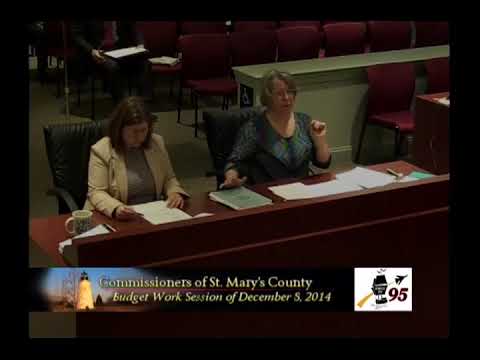
County finance staff and CIP representatives reviewed the FY2016 capital-improvement process, key calendar dates, debt policy limits and reserves, and monthly project balances during a Dec. 8, 2014 budget work session.
ST. MARY'S COUNTY, Md. — At a Dec. 8, 2014 fiscal year 2016 budget work session, county finance staff and members of the county’s capital improvements program (CIP) group briefed the Board of County Commissioners on the budget calendar, capital project schedules, and the county’s debt policy and capacity.
County finance staff framed the session as a grounding exercise for the new commission, saying the discussion would cover the budget calendar, debt policy, debt capacity and unexpended capital balances. "When the Board of County Commissioners approves the capital budget, they also approve a subsequent five-year plan," K., a county finance staff member, told commissioners, describing the plan the county uses as a touchstone when reviewing new FY2016 requests.
Why it matters: decisions made in the coming budget work sessions will determine which capital projects move forward and how they are funded — via bonds, grants, impact fees or other dedicated sources. Staff emphasized that the county typically balances project timing and funding to limit borrowing and to present a single, coordinated draft budget in February.
Key calendar and process items
- Departments must submit final county CIP sheets to finance by Jan. 5, 2015; finance will compile those into a balanced draft for the commissioners’ February work session. Jeanette, a budget staff member, walked commissioners through the calendar and deadlines. - The first major CIP work session with new requests is scheduled for Feb. 23, 2015. The complete CIP package and operating submissions are expected to be delivered to commissioners by Feb. 13, 2015 for review in mid-March work sessions. - The Board of Education’s state submission is due March 1 by state statute; the county’s public hearing on the recommended budget was listed as April 14, 2015 at Great Mills High School, followed by final county budget approval planned for May 12, 2015 and Metcom’s capital budget review later in May.
Debt policy, reserves and capacity
Staff reviewed the county’s adopted debt policy (Resolution 2009-28) and the measures used to constrain borrowing. K. summarized those limits: the legal debt limit is 2 percent of taxable assessed value and the county’s policy seeks to keep annual debt service below 10 percent of general fund revenues. For the FY2015 plan presented to commissioners, staff reported a debt-service ratio of 5.72 percent — well below the 10 percent policy threshold.
Staff presented the county’s illustrative debt-capacity worksheet for 2015: a 2 percent legal debt limit equated to about $235 million in borrowing capacity; proposed borrowing in 2015 was shown at $30 million while outstanding debt was listed at roughly $101 million, meaning the county stood at about 0.86 percent of assessed value under the legal limit. Staff said the county usually times bond sales to match cash-flow needs rather than borrowing far in advance.
The county also maintains a bond-rating reserve that the commission set at 6 percent of net recurring revenues. Finance staff said that reserve was about $10 million as of the June 30, 2014 audit and that the reserve is intended to provide stability and signal fiscal discipline to rating agencies.
Unexpended capital balances and project monitoring
Staff reviewed the monthly unexpended-balance report used to track project budgets, encumbrances and remaining appropriations. Project numbering conventions (prefixes such as PF for public facilities, HW for highways, PS for public schools, RP for recreation and parks, AP for land preservation, PL for public landings) were explained to help commissioners read project sheets.
Examples discussed: asphalt overlay projects are budgeted at $3 million per year in the plan; the NextGen public-safety project was effectively advanced a few days to capture a vendor discount staff reported as about $450,000; and the county’s central appropriation account (FIN15) holds returned or closed project funds and available appropriation authority (staff reported FIN15 included about $544,000 in state/federal appropriation authority as of the schedule discussed).
Staff said many multi-year projects remain in the CIP because of phased work, state or federal funding timing, or project-specific scheduling (for instance, projects tied to METCOM work). Commissioners were encouraged to direct follow-up questions to CIP representatives; staff noted department reports provide more granular status updates and that finance updates the unexpended schedule monthly.
Questions and next steps
Commissioners asked for follow-up detail on several items including vehicle procurement unit costs for marked sheriff’s vehicles and the asset assumptions behind recurring programs such as asphalt overlays. Staff asked commissioners to submit ideas or project changes promptly so staff can incorporate them before the Jan. 5 CIP sheet deadline.
Ending
Staff said the material presented is the start of a series of work sessions and that the finance team will return with a coordinated draft CIP and operating estimate in February. The work session closed after commissioners and staff agreed on follow-up items and the calendar for upcoming budget meetings.