Get Full Government Meeting Transcripts, Videos, & Alerts Forever!
Get email alerts on the Parking Standards topic
No spam. Unsubscribe anytime.
Sedro‑Woolley planning commission reviews major parking-code rewrite, schedules public hearing
Summary
The Sedro‑Woolley Planning Commission reviewed proposed amendments to Title 17 that would change parking dimensions, visitor‑parking ratios and underground/structured parking requirements and set a public hearing for next month.
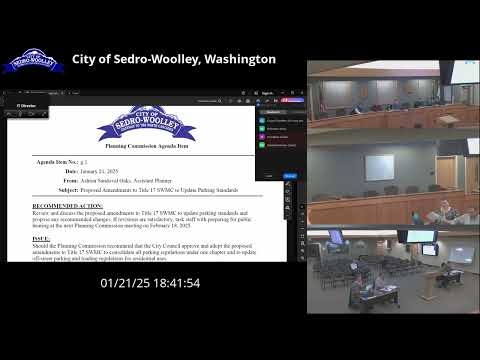
The Sedro‑Woolley Planning Commission reviewed proposed amendments to Title 17 of the Sedro‑Woolley Municipal Code that would update parking standards across multiple zones and scheduled a public hearing on the revisions for next month.
The code changes under review would consolidate parking rules into a new table, adjust guest/visitor parking ratios by unit type, increase some UVMU (Urban Village Mixed‑Use) minimums, and alter standards for structured or underground parking. Staff told commissioners the draft reduces the required share of underground or structured parking for multifamily projects from 50% to 40% and proposes narrower vehicle apron requirements in several townhouse configurations.
The changes matter because they could alter the feasibility and cost of new housing projects: higher minimum parking ratios and structured parking requirements raise development costs and can reduce unit counts on constrained sites, while lower minimums or alternative compliance options can enable denser housing.
Madison Bowman, representing BYK Construction, spoke during public comment and urged the commission to avoid changes she said would hinder housing production. “These proposed code changes…hinder the intent to provide more housing,” Bowman said. She told the commission BYK helped draft earlier UVMU parking code, that BYK both owns and manages many of its projects, and that an increase in UVMU requirements would have forced one recently built mixed‑use building to add 23 parking stalls, reducing landscaping and possibly units.
Commissioners and staff walked through specific provisions. Staff identified changes to the visitor‑parking matrix so that studios would generally require fewer visitor stalls (for example, one visitor stall per six studios versus more for larger units) and said some zones with similar densities had been aligned to the same requirements. Staff also summarized numeric changes in the UVMU table (for example, increases in the proposed parking factor for studios and one‑bedroom apartments).
Several commissioners raised operational concerns. One commissioner noted the city currently lacks strong parking enforcement staff, arguing that enforcement of existing codes could address some parking complaints without raising minimums. Another commissioner and staff discussed technical constraints: staff said local groundwater levels limit the feasibility of underground parking in some parts of town, making a 50% underground parking requirement impractical in practice.
The draft also includes a menu of reductions (public transit proximity, affordable housing provided, structured parking) that, in combination, can lower required parking; staff clarified the draft prevents stacking all three reductions to reach a large aggregate discount. Commissioners asked staff to clarify that menu with clearer “pick‑two‑of‑three” language to avoid confusion by applicants.
After discussion and requests for targeted research (including a request to re‑examine whether the UVMU and CBD standards should revert to the prior rules while increasing requirements elsewhere), the commission voted to schedule a public hearing on the parking amendments at its next meeting so the public can comment formally. Staff said it would circulate BYK’s written submittal and the revised draft before the hearing.
Next steps: staff will incorporate the feedback (clarify the reduction menu, re‑check apron and MADA/fire access rationales, collect written comments like BYK’s eight‑page submission) and place the item on the next meeting agenda as a noticed public hearing.