Get Full Government Meeting Transcripts, Videos, & Alerts Forever!
Get email alerts on the Transfer Of Development Rights topic
No spam. Unsubscribe anytime.
St. Mary’s County hearing draws opposition to proposed exemptions from TDR requirement
Summary
At a March 12 public hearing in Leonardtown, St. Mary’s County officials heard objections from farmers, former TDR task-force members and landowners to a zoning text amendment that would exempt certain civic and institutional uses from purchasing transfer-of-development-rights (TDRs) or achieving LEED certification to increase floor area ratio.
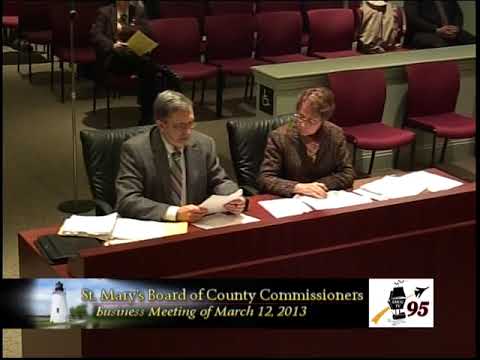
LEONARDTOWN, Md. — The St. Mary’s County Board of County Commissioners on March 12 heard public opposition to a proposed zoning text amendment that would alter methods for achieving increases in floor area ratio (FAR), potentially exempting some civic and institutional uses from the county’s transfer-of-development-rights (TDR) requirements.
Land Use staff presented a draft that would replace the term “public and semi‑public” with “civic and institutional” in the zoning ordinance, move six use types (including certain daycare and medical uses) into the commercial classification, and add a footnote (footnote 6 to Schedule 32.2) that could exempt qualifying civic and institutional developments from having to purchase TDRs or obtain LEED certification to exceed base FAR limits. The board opened a public hearing and said it would accept written comments for 10 more days.
The proposal and the planning commission’s recommended language prompted sharp objections from agricultural and preservation stakeholders. Joseph Wood, a Mechanicsville resident and participant in the county’s prior rezoning work, told commissioners, “we are opposed to an exemption for the TDRs,” saying the program was a negotiated compromise to sustain agricultural land and compensate owners who forgo development rights.
Jamie Raley, president of the St. Mary’s County Farm Bureau, told the board the Farm Bureau’s directors — representing about 900 members — oppose amendments that “would modify the methods for achieving an increase in floor area ratio by exempting public and semi‑public uses.” Raley cited minutes showing the planning commission approved its recommendation on a 4–3 vote and said the commission had suggested a three‑year sunset clause for any exemption. Raley also noted a county memo stating that the “Watershed Implementation Plan and the Sustainable Growth and Agricultural Preservation Act of 2012” (the transcript caller the “septic law”) could affect the long‑term need for the TDR program, but that uncertainty did not justify weakening the program now. He added that “1,250 St. Mary’s County land owners have already seen their properties devalued due to the septic law.”
George Boroniak, who said he served on the original county TDR task force, urged commissioners not to grant waivers or exemptions. “We put a lot of effort into this program,” he said, and the task force concluded “everybody should participate in the overall TDR program to make it work.” Boroniak recalled the group considered contingency language for cases when TDRs were not available.
County Attorney Sparling warned the board of legal risks in the planning commission’s recommended wording. Sparling told commissioners he had “a lot of trouble with the planning commission’s recommendation” because the draft criteria (that a development “provide a basic or fundamental public service or public amenity,” be “available to the general public,” and “serve primarily the local community”) could exclude organizations that are tax‑exempt under federal law but not open in the same way locally — for example, some church‑related schools. He recommended the board consider the department’s original language or substantially rework the proposed criteria to avoid unintended exclusions.
Land Use staff clarified that the draft would limit eligibility by requiring a development to be listed in Schedule 50.4 (the use table) as a civic or institutional use and outlined the civic/institutional categories (including religious assembly, government facility, education facilities, public safety facility and others). Staff also said six specific uses previously classified as public/semi‑public — including nonmedical daycare, hospitals, long‑term care facilities, outpatient care centers and rural medical practices — were moved into the commercial classification to narrow the exemption’s scope.
Speakers from the public emphasized the program’s origins and complexity; several speakers said the TDR program was the result of months of stakeholder work and should not be weakened. Farm Bureau materials, provided to the board, urged rejection of the exemption language. The board also received a letter delivered the morning of the hearing from a local citizen opposing exemptions, which staff summarized for commissioners.
After public comment, the board closed the public hearing and reiterated it would accept written comments by mail for 10 days to Post Office Box 653, Leonardtown, MD 20650. The commissioners then moved to an executive session on personnel matters; a motion to go into executive session was seconded by Commissioner Morgan and approved with the board’s ayes.