Get Full Government Meeting Transcripts, Videos, & Alerts Forever!
Get email alerts on the Capital Budget topic
No spam. Unsubscribe anytime.
St. Mary’s County work session: draft CIP balanced but commissioners debate impact-fee study
Summary
County staff presented a draft FY14–FY19 capital improvement plan (CIP) that balances sources and uses and shows a higher impact-fee need than current rates; commissioners debated whether to commission a new impact-fee study and asked staff to consider economic uncertainty and sequestration risks.
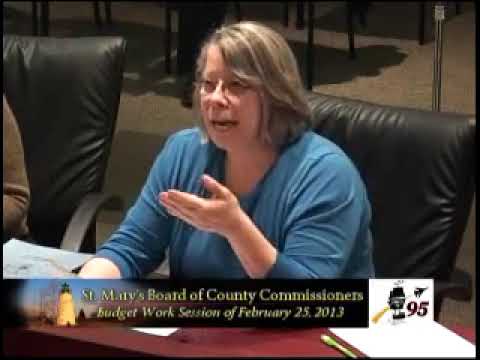
St. Mary’s County commissioners reviewed a draft FY2014–2019 capital improvement plan during a Feb. 25 budget work session and were told staff had balanced sources and uses for the first time before the session, while also flagging a large gap between the county’s current per-unit impact fee and the updated calculation.
County budget staff presented a packet that included project detail sheets, a 14-page schedule of operating and debt impacts, and an updated impact-fee calculation. Elaine Cramer, the county finance staff member leading the presentation, said the updated per-dwelling-unit impact-fee estimate in the county’s model rose from $14,905 in the prior update to $15,464 in the current calculation and contrasted that with the county’s adopted fee of $4,500 per dwelling unit.
Why this matters: commissioners must weigh whether to leave current fees unchanged, risking a growing gap between fee revenue and projected capital needs, or to commission a formal update that could recommend higher fees. Several commissioners voiced concern about ordering an expensive study while near-term residential growth appeared minimal and federal sequestration posed revenue risks.
During discussion, Phil (county staff) told commissioners the county saw roughly 200 new housing units in the previous year, well below the long‑term pace used in earlier projections. Commissioner Todd B. Morgan and other commissioners argued a fresh study could show how much the county’s fee is undercharging compared with neighboring jurisdictions, while Commissioner Cynthia L. Jones and another commissioner said low near‑term growth and sequestration risks counseled caution about raising fees or beginning a study now.
The packet also included a six‑year view of impact-fee collections by category (roads, parks, schools). Staff noted the draft plan applies $1,012,500 of road impact fees in FY14 while estimating $1,687,500 would be available over the six‑year period, and it showed how some fees are being banked for future qualifying projects. The staff presentation explained PAYGO (pay‑as‑you‑go) general fund transfers and how transfer-tax carryover and timed project eligibility affect cash flows.
Commissioners directed staff to keep the impact‑fee issue on the table for further consideration, factor sequestration and near‑term growth uncertainty into recommendations, and to provide a clear estimate of PAYGO demands in FY14 when the recommended budget is circulated. No formal action or vote on fee changes occurred at the session.
Staff said they would return with a concise summary of the revisions the board requested and the fiscal effect on borrowing capacity and PAYGO usage ahead of the next budget steps.
Ending: The board left the draft CIP broadly intact but signaled it wants additional analysis on impact‑fee methodology and near‑term revenue risk before considering changes to the county’s $4,500 per‑unit fee.