Get Full Government Meeting Transcripts, Videos, & Alerts Forever!
Get email alerts on the Capital Funding Fin12 Paygo topic
No spam. Unsubscribe anytime.
Commissioners agree to use FIN 12 funds to start three county capital projects; staff to fold refunding savings into PAYGO for FY13
Summary
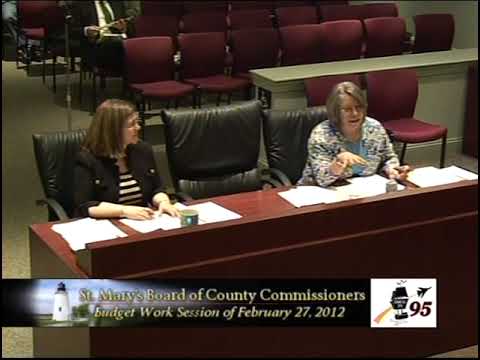
St. Mary's County commissioners on Feb. 27 agreed to use part of the county's FIN 12 capital reserve to start three near-complete projects and asked staff to fold debt-refunding savings into PAYGO (pay-as-you-go) funding to help balance the fiscal 2013 capital plan.
St. Mary's County commissioners on Feb. 27 agreed to use part of the county's FIN 12 capital reserve to start three near-complete projects and asked staff to fold debt-refunding savings into PAYGO (pay-as-you-go) funding to help balance the fiscal 2013 capital plan.
The projects the board identified for FIN 12 funding are Carver Heights Park, the Mattapani bathrooms/administration/demo kitchen tied to the farmers market, and State Highway Administration (SHA) entrance improvements. County finance staff briefed commissioners on Attachment C of the agenda, which shows the FIN 12 balance and candidate uses.
The commissioners and staff described the FIN 12 as a capital reserve made up of project closeouts, adjustments and the one‑time debt service savings from a recent refunding. Elaine Kramer, the county chief financial officer, said the current FIN 12 available amounts include $183,955 of transfer tax, $994,792 of PAYGO, and smaller balances in impact-fee and mitigation accounts. The three projects the board flagged total about $392,807.
The board’s verbal consensus was to authorize staff to plan to use FIN 12 funds to start those projects and to return with formal budget amendments. “The request is really would you entertain using some of the FIN 12 money that we've accumulated in order to get those projects started and done,” Kramer said in the meeting packet discussion; commissioners responded in the affirmative.
Separately, Kramer and other staff proposed applying recent refunding savings and available reserve balances as PAYGO to reduce the FY13 bond issuance. Staff identified roughly $1,169,000 in FY13 debt-service savings from a fall refunding, about $400,000 carried into FIN 12 from FY12 refunding savings, and a $662,000 reserve carried forward from an earlier year. Kramer asked whether the board wanted to use those amounts as PAYGO to reduce bond sales that would otherwise fund FY13 projects. She said a package of “all three of them” would total about $2.3 million and would reduce the need to sell bonds for FY13 projects.
Commissioners expressed interest in using some portion of those funds now and leaving staff flexibility to revisit the balance later in the fiscal year as updated revenue and BOE requests arrive. John Savage, county administrator, and staff said if the board gave direction at the session, formal budget amendments would follow later to effect the transfers.
Why it matters: Using one-time refunding savings and FIN 12 carryovers as PAYGO reduces near-term borrowing and the county’s long-term debt service obligations, while allowing selected park and facility projects that are close to completion to move forward without waiting for the FY13 capital budget cycle.
Outlook: Staff will return with formal budget amendments to move FIN 12 funds into the three projects and with a balanced FY13 capital plan that reflects any PAYGO direction provided by the commissioners. Kramer said she expected more updated numbers over the next few weeks as board of education amendments and year‑end closeouts are finalized.
Ending: The commissioners directed staff to proceed with preparing amendments and to hold remaining FIN 12 resources pending further updates from departments and the board of education.