Get Full Government Meeting Transcripts, Videos, & Alerts Forever!
Get email alerts on the Capital Budget topic
No spam. Unsubscribe anytime.
St. Mary's County commissioners review $58.7 million draft FY2015 capital budget and six-year CIP
Summary
At a Feb. 24 budget work session the St. Mary's County Board of County Commissioners reviewed a draft FY2015 capital budget of $58,734,935 and a six-year capital improvement plan through FY2020, focusing on county funding needs, impact fees, bonds and operating impacts.
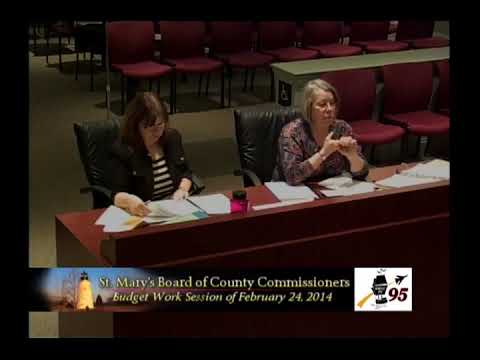
The St. Mary’s County Board of County Commissioners heard an overview of the county’s draft capital improvement plan and the draft FY2015 capital budget at a Feb. 24 budget work session in Leonardtown.
Chief Financial Officer Elaine Kramer told commissioners the FY2015 draft capital budget totals $58,734,935, of which $41,295,407 is proposed as county-funded. Kramer said the packet for the work session included 148 pages of project detail sheets and a buff insert with late updates for selected projects, and warned there could be modest changes before final adoption.
The presentation prioritized local funding sources and described how staff applied available state and federal funds first, then used impact fees, PAYGO, transfer taxes and general obligation bonds to balance the plan. Kramer said the draft assumes borrowing of $30 million in 2015, $20 million in 2016 and 2017, and $20 million in 2019, based on project timing and cash-flow needs. She noted the county has not sold bonds since 2009 and that the draft stays well within the county’s debt policies: outstanding debt expressed as a percentage of the base remains below the 2% policy and debt service as a percentage of the budget is below the 10% policy.
Kramer and staff walked commissioners through funding-source assumptions for impact fees (schools, roads and parks) and noted they applied $17.6 million in school impact fees in the draft. On impact fees, Kramer said the board previously adopted the fee methodology and that the county annually updates the calculation; the FY2014 update increased the overall impact-fee total used in the draft to about $17,392 per dwelling after combining school, roads and parks components.
Staff also described the agency approach to PAYGO, transfer taxes and bond financing, and said PAYGO was used primarily for smaller, short-lived capital items where debt financing did not make sense. Kramer advised that if the board chose to reduce PAYGO the county would substitute transfer tax or bond financing to preserve project funding.
Why it matters: The CIP determines the county’s capital spending and influences future operating budgets and debt issuance. Commissioners asked staff for clarifications on project timing and operating impacts so that the FY2015 operating budget can be adjusted where projects add recurring costs.
Commissioners directed staff to continue refining the CIP details and to return with further information on individual projects as requested