Get Full Government Meeting Transcripts, Videos, & Alerts Forever!
Get email alerts on the Labor And Unions topic
No spam. Unsubscribe anytime.
Committee hears divided testimony on HB 211 to extend collective bargaining to graduate assistants and postdocs
Summary
Delegate Linda Foley presented HB 211 to the Appropriations Committee, seeking to extend collective bargaining rights to graduate assistants and postdoctoral associates at USM campuses, Morgan State and St. Mary’s College of Maryland.
Delegate Linda Foley presented House Bill 211 to the Appropriations Committee, proposing to extend collective bargaining rights to graduate assistants and postdoctoral associates at the University System of Maryland (USM), Morgan State University and St. Mary’s College of Maryland.
Foley said the measure would allow these academic workers to choose a union representative and bargain over working conditions; she emphasized that the bill does not by itself raise salaries or expand university budgets but instead enables employees to negotiate how existing funds are allocated. She asked the committee for a favorable report and introduced a panel of graduate students, postdoctoral researchers and union representatives who testified in support.
Supporters’ testimony: several witnesses told the committee graduate and postdoctoral workers perform essential university labor — teaching, grading, research and grant administration — and lack legally enforceable employment contracts. Isabella O’Malley said a union card signed by about 2,500 graduate workers at the University of Maryland shows majority interest; she said collective bargaining would secure designated workspaces, neutral grievance procedures and fair workload distribution. Alexandra Foley of the United Auto Workers (UAW) said the union represents more than 100,000 academic workers nationally and urged the committee to enable workplace democracy; she told the committee, “House Bill 211 is fundamentally about workplace democracy.”
Matthew Brown, a postdoctoral researcher and union member, said union membership when he was a graduate student improved student outcomes, grant funding and research productivity. Donna Edwards and other supporters told members that graduate workers bring grant dollars to campuses and that existing campus human‑resources offices already handle collective bargaining for other employee groups.
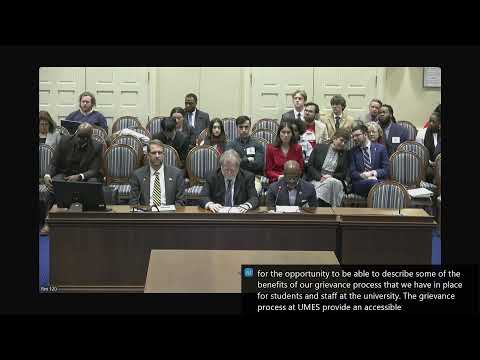
Opponents’ testimony: officials from the University System of Maryland and multiple campuses urged caution and asked the committee to deny the bill. Allison Ren (senior vice chancellor for academic and student affairs, USM) said USM respects graduate students and postdoctoral associates but that mentorship, meet‑and‑confer processes and grievance procedures currently address many concerns; she warned collective bargaining could change that dynamic.
Roger Ward, provost at University of Maryland, Baltimore, said postdoctoral trainees are mentorship‑based and not traditional employees; he raised immigration concerns, saying UMB has about 300 postdocs and roughly 65% are on temporary visas with strict federal work requirements that could conflict with collective‑bargaining terms. Sherry Roxas, director of labor at USM, described the organizing process and argued that the statutory election process can bind an entire bargaining unit based on majority votes of participants in an election and that some institutions with bargaining rights have higher tuition.
Campus academic leaders from Towson, Morgan State and the University of Maryland Eastern Shore described existing graduate student governance, grievance procedures and staffing. Morgan State’s Mark Garrison and Towson’s David Ownby noted tight budget constraints for stipends and warned that mandatory increases would reduce the number of funded assistantships in a fixed budget environment.
Committee members asked about fiscal notes and whether enabling legislation itself creates costs; witnesses and the sponsor agreed the bill is enabling legislation and that any specific contract costs would require mutual agreement. Committee members also questioned how collective bargaining would interact with visa rules and federal grant funding; opponents said federal grant terms and visa regulations complicate implementation, while supporters replied that these are bargaining issues to be addressed at the table and that many peer institutions already recognize bargaining rights for graduate workers.
The committee did not take a vote at the hearing; Committee leadership signaled the bill is likely to come up for a vote next week.