Get Full Government Meeting Transcripts, Videos, & Alerts Forever!
Get email alerts on the Water Infrastructure topic
No spam. Unsubscribe anytime.
Arizona Water Company briefs council on east‑side wastewater plan and new assured water‑supply approach
Summary
Arizona Water Company updated the council on a proposed modular wastewater reclamation project on Casa Grande’s east side and its work on an Alternative Designation of Assured Water Supply (ADOS) that combines CAP water, reclaimed effluent and developer-supplied supplies to enable new subdivisions.
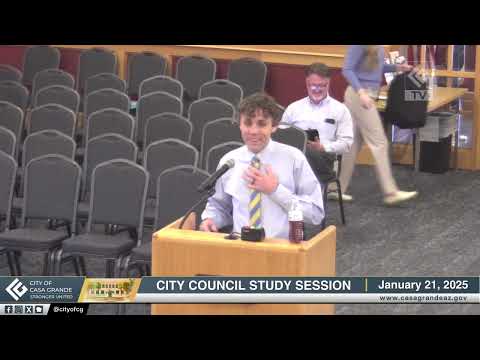
Fred Schneider, president of Arizona Water Company, and Terry Sue Rossi, the company’s vice president of water resources, briefed the City Council on plans for an east‑side wastewater treatment and reclamation project and on a new method for securing long‑term water supplies for development.
Schneider summarized the wastewater plan, saying the initial construction phase covers service to several planned developments and would form part of two eventual water reclamation facilities east of Interstate 10. He said the company’s Central Arizona Corporation Commission (CCN) application describes about 6,900 residential equivalent dwelling units and an initial treatment capacity of roughly 1,700,000 gallons per day.
“We are looking to ultimately have two wastewater facilities on the east side of I‑10,” Schneider said, describing an initial south facility (near Post Ranch) intended to recharge the first 2–3 million gallons per day and a future north regional facility off Overfield Road for larger‑scale recharge and recovery.
Schneider described a modular design approach with Perkwater (reported in the presentation materials as a partner) to allow staged plant expansion and said the first phase design was expected to start in April 2025. He outlined a permitting timeline the company provided to council: local review of wastewater (CSIN) and plan approvals, Arizona Corporation Commission CCN approval anticipated in March 2025, followed by state environmental (ADEQ/DEQ) and EPA approvals in 2026, and a target for plant start‑up in late 2027 depending on development timing.
Council members asked about finances and operations. Schneider said project funding is expected to come from a combination of developer contributions and Arizona Water Company investment, not city general fund dollars; developers typically pay hookup and refunding fees, and the company expects to haul flows to a City facility temporarily until the plant reaches steady operation. He said trucks would avoid driving through downtown and that haul routing would be planned accordingly.
Terry Sue Rossi reviewed the Alternative Designation of Assured Water Supply (ADOS), a newly available method from the Arizona Department of Water Resources that allows designation at the service‑area level rather than only by individual subdivision certificates. Rossi said the approach is intended to reduce reliance on groundwater by combining CAP water, reclaimed effluent and other alternative supplies.
“Our community farms and businesses need water to thrive, and we risk becoming too dependent on groundwater,” Rossi read from the team’s policy message. “Therefore, in order to protect our quality of life, help meet future water needs, and grow our economy, we need to reduce our reliance on groundwater, invest in sustainable water supplies, and use the water we have more efficiently.”
Rossi explained how the designation works in practical terms using a development example: if a new subdivision’s demand is 300 acre‑feet, the rule requires a grossed‑up supply (400 acre‑feet) so 25% can be dedicated to offset existing groundwater use; Arizona Water Company would contribute CAP entitlement (example 100 acre‑feet), the city would contribute reclaimed effluent (example 100 acre‑feet) and the developer would acquire the remaining supply (example 200 acre‑feet). Rossi said using CAP water and effluent together can substantially lower per‑unit water acquisition costs in the example the presenter gave — roughly $8,300 per home with the combined approach compared with about $16,700 per home if a developer procured all supply alone.
Rossi and Schneider emphasized that effluent’s value depends on where it can be recharged and recovered: ADWR’s area‑of‑hydrologic‑impact (a one‑mile “safe harbor” ring around recharge sites) is a key planning constraint, and moving recovered CAP water and effluent into those areas supports the designation. They said current modeling commonly assumes 33% of potable use returns as effluent but that local data may support higher recovery percentages, which would improve the cost outlook.
City Manager Larry Raines and council members asked clarifying questions about financing, timing, haul logistics and whether the city would be giving up control of effluent; Raines said the city is likely to consider policy questions about effluent allocation and that dedicated licensing agreements would define how effluent generated in specific areas is used. Schneider said the company intends that effluent generated in the project area “will be utilized and stay within the Casa Grande area.”
No council votes or binding decisions were taken; presenters and staff said the topic will return to the council for future briefings and that further technical, modeling and legal work with ADWR remains to finalize the approach.
Ending: Council members thanked Arizona Water Company for the update; staff said they will provide additional briefings and continue working with developers and ADWR as the permitting and designation process continues.