Get Full Government Meeting Transcripts, Videos, & Alerts Forever!
Get email alerts on the Infrastructure Pavement topic
No spam. Unsubscribe anytime.
Tooele County unveils new pavement-mapping system and five-year planning tool
Summary
Public works staff presented a countywide pavement assessment using survey-grade equipment, mobile lidar and AI software; the inventory covers about 400 miles, the county PCI is about 59, and staff said the data will guide a five-year maintenance plan and annual budgets.
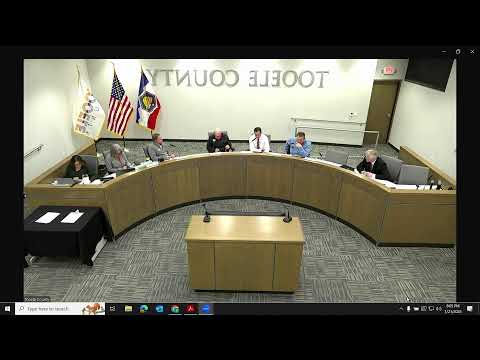
Public Works staff presented a countywide pavement assessment to the council on Jan. 21 that combines survey-grade edge-of-asphalt mapping, mobile lidar and high-resolution imaging analyzed in a web platform called InForm.
Jed (staff member) said survey crews mapped the edge of pavement on both sides of county roads and that a vendor collected pavement-distress imaging at roughly 1-millimeter resolution with 360-degree cameras and 3-D lasers. He said the county’s inventory is about 400 miles and the network-wide pavement condition index (PCI) is about 59.
"Our overall PCI of our entire network is 59," Jed said, describing that result as ‘‘borderline of good and fair’’ and saying about 75% of the inventory is in marginal-or-better condition while roughly 25% is poor or very poor, which would require thicker overlays or reconstruction.
Jed and colleagues said the cost for the data collection ranges roughly from $150 to $250 per mile depending on project size. They described how chip seals can register poorly on the system’s roughness index even though chip-sealed roads are preserved from UV and may be in good condition for their intended service.
The presentation included sample segment maps and a video-driven interface showing the images and detected distresses. Jed said the county will use the data to build a repeating five-year plan and to evaluate whether annual pavement investments move the system PCI in the desired direction.
Budget figures discussed during questions included about $700,000 budgeted this year for pavement treatments overall, roughly $300,000 for chip seal work (about 20 miles a year), $300,000 for contracted preservation (slurry, crack sealing and similar treatments) and $100,000 set aside for overlays.
Jed recommended continuing a balanced approach that preserves higher-condition roads with preventive treatments while addressing the worst segments with reconstruction where necessary. Council members discussed possible regional cooperation through the Council of Governments (COG) to standardize data collection across jurisdictions.
Staff did not ask the council to approve an immediate capital commitment during the presentation; the maps and condition scores are intended to inform future budget decisions and grant-seeking.