Get Full Government Meeting Transcripts, Videos, & Alerts Forever!
Get email alerts on the Crisis Stabilization Units topic
No spam. Unsubscribe anytime.
Regions describe crisis-stabilization gaps and bed-count tradeoffs; IMD rules cited as reimbursement constraint
Summary
Directors told the Appropriations Committee that several regions lack operational crisis stabilization units (CSUs) and that recent RFPs drew few bids. Testimony addressed bed-count design (10 vs. 16 beds), staffing ratios, and the Medicaid IMD exclusion that affects funding for inpatient beds above 16.
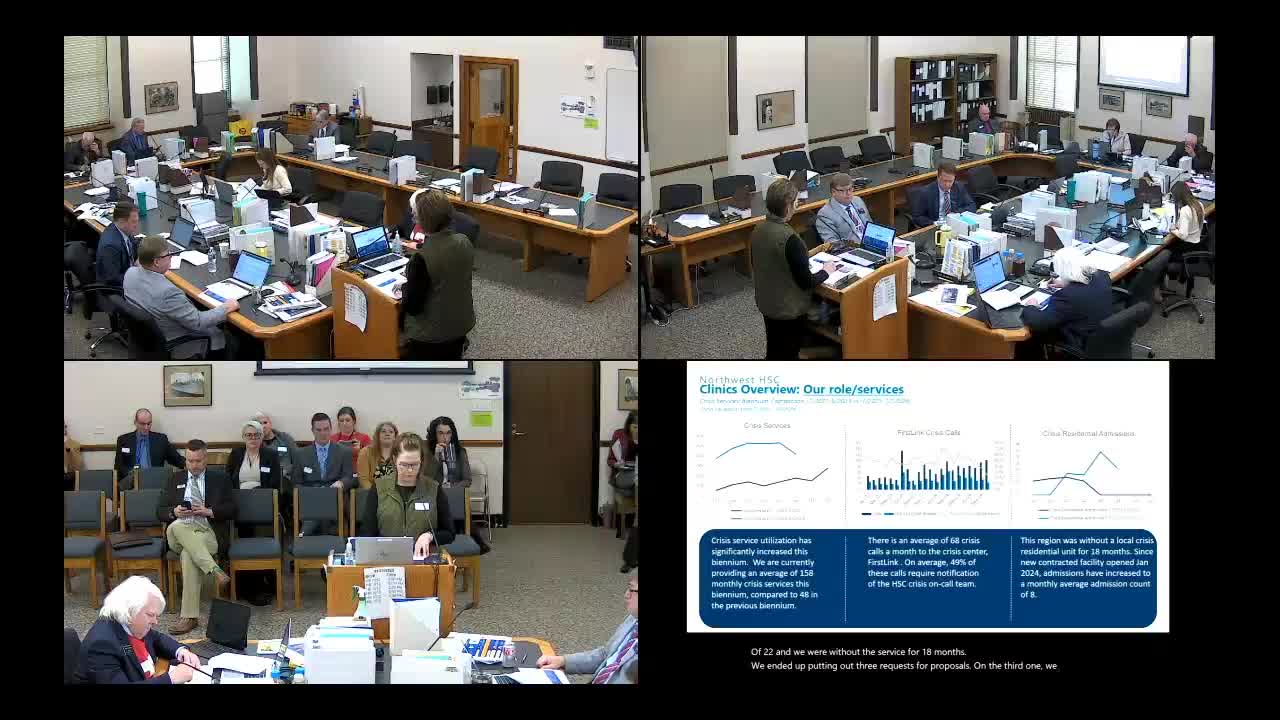
Shar Farrell told lawmakers that Northwest’s crisis stabilization residential contract with a previous vendor ended in July 2022 and the center is now contracting with “Center Inc.” under a contract awarded September 2023 that began operations in January 2024.
Lake Region director Julie Baumgard said her region has been without a crisis stabilization unit since June 2023 and that a current request-for-proposals (RFP) remains pending; initial market feedback for her region recommended a 10-bed model rather than 15–16 beds because staffing ratios (often three staff on duty per shift for larger units) make larger units difficult to staff in rural areas.
Committee discussion explained the federal Medicaid IMD (Institutions for Mental Diseases) exclusion and its impact on bed counts: participants said a 16-bed facility can receive Medicaid reimbursement under existing rules for certain settings, whereas facilities larger than 16 beds may be excluded from Medicaid reimbursement and rely on state or private funds. Committee members said states sometimes pursue waivers but pointed out that applying for a waiver is lengthy and not certain.
Witnesses also said CSU availability affects transports and inpatient admissions and that adding outpatient and transitional beds would expand treatment options. Shar Farrell and John Buttcrite said their centers currently operate or contract CSUs with partial capacity — Northwest reported 7 crisis beds in active use and 3 set aside for transitional living in one facility, and North Central reported operating its own Open Arms CSU and serving multiple regions.
Ending — Presenters asked for support to recruit staff for CSUs and to consider the tradeoffs between bed counts, staffing feasibility and reimbursement rules as the committee considers behavioral-health infrastructure investments.