Get Full Government Meeting Transcripts, Videos, & Alerts Forever!
Get email alerts on the Telehealth Crisis Response topic
No spam. Unsubscribe anytime.
Regional directors report uneven rollout of Veil eCare; McKenzie County highest user
Summary
At an Appropriations Human Resources Division hearing, three regional directors told lawmakers that tele-evaluation service Veil eCare went live in 2024 and reduced hospitalizations where used, but utilization varies widely across counties; McKenzie County reported heavy use while several rural counties report little or no uptake.
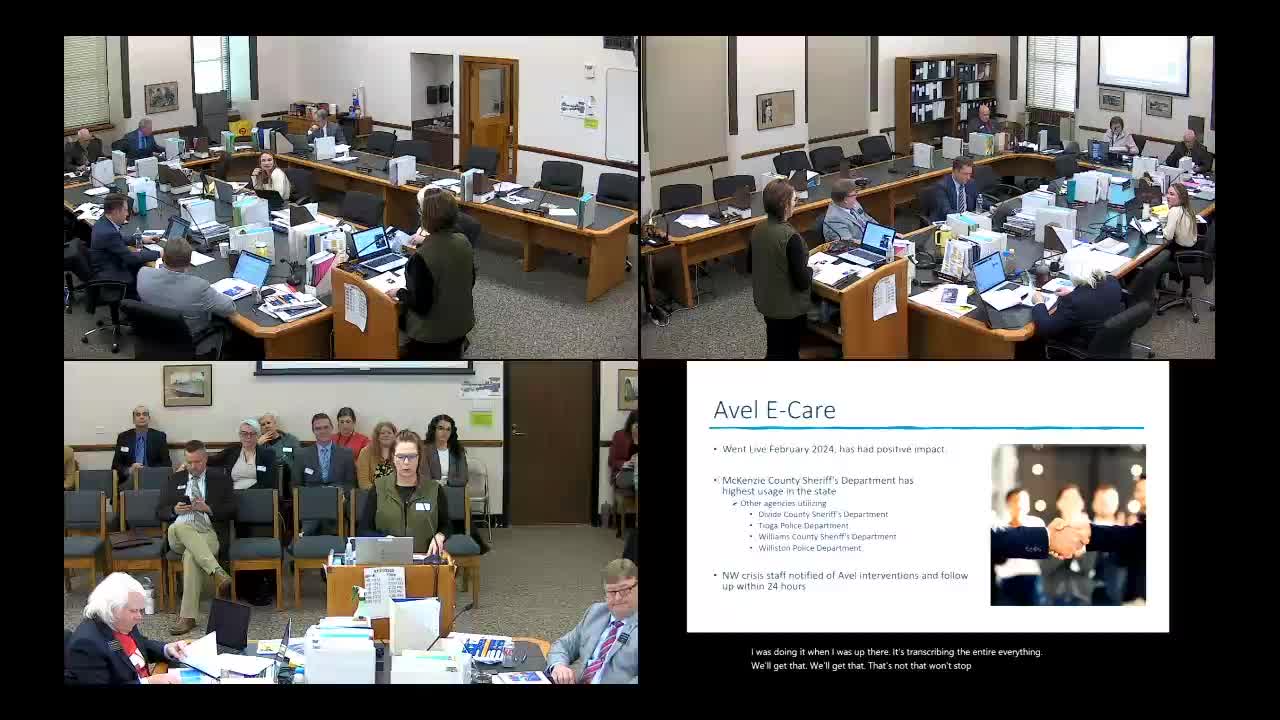
Shar Farrell, regional director at Northwest Human Service Center in Williston, told the Appropriations Committee that “Veil eCare Services” went live in her region in February 2024 and has shown a “quite a positive impact.” She said McKenzie County had the highest usage in the state and that other local law-enforcement agencies in her region — including Divide County and Williams County sheriff’s offices and Tioga and Williston police — were using the system.
Farrell said Northwest staff are notified of Veil interventions and follow up within 24 hours, usually within 12, and that most activations do not result in hospitalization. “Most of the time when a Veil is involved, it does not result in a hospitalization,” she said.
John Buttcrite, regional director at North Central Human Service Center in Minot, also described Veil use and said the region initially saw high activation rates but that use had fallen in some places. Buttcrite said his newly hired behavioral health liaison will focus on outreach to law enforcement and other partners to increase appropriate use. “When they are activated…we have a phone response first. If that is sufficient to meet the need, then it ends there,” he said, adding that his region has been doing more in-person responses as staffing permitted.
Julie Baumgard, regional director at Lake Region Human Service Center, told lawmakers her region’s uptake has been low. She said five of six counties in her region opted in when the system went live in March 2024 but that only one county has used it. She cited turnover and device/operational barriers — for example officers not wanting to pick up a tablet before responding — as recurring impediments and said a newly hired behavioral health liaison will work to identify local champions to promote use.
Committee members pressed for follow-up. Chairman Nelson asked staff to invite a McKenzie County law-enforcement representative to testify about how the county is implementing Veil eCare. Several presenters and legislators emphasized that the service appears to reduce hospital transports when it is used but that rural geography, staffing shortages and local preferences about on-scene evaluations affect uptake.
The testimony did not include a statewide utilization rate or a complete county-by-county usage breakdown; several presenters said they were still gathering data and conducting outreach to law enforcement and community partners.
Ending — Lawmakers said they intend to follow up with counties and vendors to understand barriers to use and whether the state should change training, device distribution or other supports to increase effective deployment of the tele-evaluation tool.