Get Full Government Meeting Transcripts, Videos, & Alerts Forever!
Get email alerts on the Long Term Care Resident Rights topic
No spam. Unsubscribe anytime.
Senate Human Services Committee approves amendments to long-term care resident-rights bill
Summary
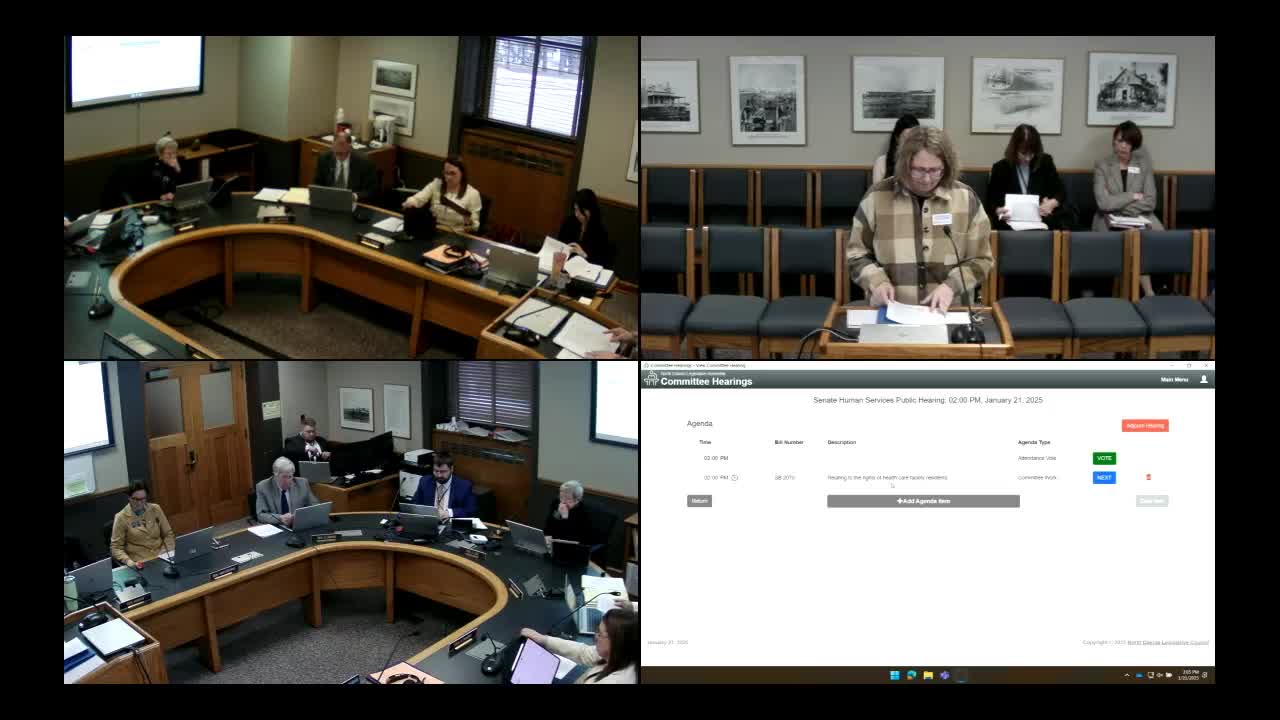
The Senate Human Services Committee voted 6-0 to adopt department-proposed amendments to Senate Bill 2070, changing several proposed resident-rights provisions after testimony from the State Long Term Care Ombudsman and provider representatives.
The Senate Human Services Committee agreed unanimously to adopt amendments to Senate Bill 2070 after testimony from the State Long Term Care Ombudsman and provider representatives.
The amendments, presented by Carla Backman, the State Long Term Care Ombudsman, reverted a proposed 14-day timeframe back to the bill’s original 30 days and removed or revised several proposed provisions she said would be difficult for assisted-living facilities to implement. "Bringing forward today some amendments to Senate Bill 2070...reverting taking out the proposed change from 14 days and reverting back to the original language of 30 days," Backman told the committee.
Why it matters: The bill would change how long-term care facilities communicate and operate around admission, discharge, and residents’ rights. Committee members and witnesses said some provisions in the initial draft were modeled on federal nursing-home rules that do not map neatly onto assisted living and basic care settings.
Key changes and discussion - Timeframe: The committee adopted language reverting the proposed 14-day standard to the bill’s original 30 days, a change Backman said the provider association requested so residents and staff would have more time to adjust.
- Admissions, discharge and transfers: The committee removed proposed sections related to discharge locations and discharge preparation that Backman and provider representatives said would be infeasible for assisted-living settings. Backman described the removed material as "all of page 6" and said assisted-living providers told the group the requirements were not feasible for their level of licensing and operation.
- Physician choice and clinical authorization: The draft’s proposed right for residents to choose an attending physician was removed after providers raised practical concerns. Separately, the amendments added nurse practitioners and physician assistants to the list of clinicians who can authorize and administer certain drugs in long-term care settings.
- Billing and payment language: The amendments remove proposed language about facility billing systems after providers said they already shared such information and preferred that paragraph dropped. The committee also removed a sentence that would have required facilities to "inform the resident in writing if the inability to verify a viable payment source is the reason for denial of admission," at providers' request.
- Privacy and monitoring: Backman said the language about virtual monitoring devices was revised after testimony from the assistant attorney general. "Based on the testimony of Marina Sparr, assistant attorney general...she did not like the language that virtual monitoring a device, if it was used to record, or that the language stated that it could not be used to record. And so it was changed to, if it is used to record, then the sections that apply to authorize electronic recording would all apply," Backman said. The amended text ties any recording to the existing authorization and consent processes rather than categorically banning or allowing it.
- Liability clause removed: The committee also removed proposed language that would have stripped criminal or civil liability under the code, following concerns flagged by the assistant attorney general and summarized by Backman.
Who testified: In addition to Backman, Shelley Peterson, a consultant with the provider association, urged caution about applying federal nursing-home rules to assisted-living settings. "Clearly, nursing homes are the most regulated when you look at basic care nursing homes and assisted living," Peterson said, explaining that assisted living residents are generally more independent and governed by different legal frameworks such as contract and landlord-tenant rules.
Committee action and votes - Motion to adopt the department-proposed amendments: Moved by Senator Roars, seconded by Senator Hogan; roll call 6-0 (Yeas: Senator Lee; Senator Weston; Senator Roars; Senator Hogan; Senator Van Osteen; Senator Clemens). Outcome: adopted.
- Motion to give the bill a "do pass" as amended: Moved by Senator Roars, seconded by Senator Clemens; roll call 6-0 (Yeas: Senator Lee; Senator Weston; Senator Roars; Senator Hogan; Senator Van Osteen; Senator Clemens). Outcome: do pass as amended.
Procedure and next steps: Committee members said most changes reflected a negotiated, line-by-line review with provider groups and the ombudsman office. A committee member volunteered to carry the bill to the next stage. Committee staff and sponsors did not provide a fiscal note during the hearing; senators asked staff to supply any required fiscal detail later in the process.
The committee’s action sends the amended SB 2070 forward for further consideration.