Get Full Government Meeting Transcripts, Videos, & Alerts Forever!
Get email alerts on the Metro Arts Grants topic
No spam. Unsubscribe anytime.
Committee approves Metro Arts grant criteria, requires fiscal sponsors for individual Thrive awards
Summary
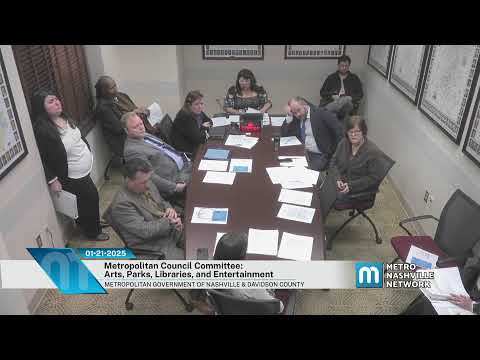
The Arts, Parks, Libraries & Entertainment Committee on Jan. 21 approved RS 2025‑961, a resolution that sets criteria for Metro Arts operating support and Thrive grants and requires nonprofit fiscal sponsors for awards to individuals; the measure passed 6‑0.
The Arts, Parks, Libraries & Entertainment Committee on Jan. 21 approved RS 2025‑961, a resolution that sets the criteria for operating support and Thrive grants administered by Metro Arts and requires the use of nonprofit fiscal sponsors for award recipients who are not incorporated organizations. The committee passed the amendment and the resolution as amended by a 6‑0 vote.
The resolution implements a grants and funding plan staff prepared for the committee and the Arts Commission, formalizing allocation formulas and reporting requirements. Ashley Batchelder, currently director of policy and research at the Metro Human Relations Commission (MHRC) and the incoming interim executive director of Metro Arts, told the committee the package goes “much more than what's required in the code” to clarify grant administration after a year of delays and public concern. She said the city allocated $3.2 million to Metro Arts in the prior year for both operating and Thrive awards and that applications submitted in January 2024 have been waiting about a year for resolution.
The resolution responds in part to a Title VI conciliation process triggered by a civil‑rights complaint. David Tucker, executive director of the Metro Human Relations Commission, said the resolution is the final element of that conciliation work and that ``MHRC is in full support of this, and we wish that this would pass.''
Why it matters: Metro Arts is trying to clear a backlog of 2024 applications while complying with legal limits on distributing government grant funds to individuals. Staff told the committee the total requests for grants roughly triple the available budget, forcing choices about how to allocate funds between general operating grants for arts organizations and Thrive awards that target individual artists and small, informal groups.
Key details and debate
- Allocation history and proposals: Batchelder reviewed recent allocation shares, saying Thrive received about 6% of Metro Arts funding in 2023 and rose to higher shares in later cycles. She told the committee staff recommended funding Thrive at 28% of the grants allocation; the Arts Commission increased that figure in its actions and the proposal presented to committee reflected a substantially larger Thrive allocation (discussed by staff as 40% in the presentation).
- Fiscal sponsorship requirement: Because state and local law prohibit direct distribution of government grant funds to individuals, RS 2025‑961 requires that awards to non‑501(c)(3) recipients be paid through a nonprofit fiscal sponsor. Batchelder said Metro Arts will require a template letter of agreement with each application showing the fiscal sponsor and proposed disbursement schedule; the application window will reopen for four weeks to allow applicants to submit the required information.
- Duties and liability: Tess Ortiz Marsh, counsel to Metro, described the contractual relationship: Metro will contract with a fiscal agent; the contract will state that the money is for a named artist and that the fiscal agent is the grantee for Metro’s purposes. She said the fiscal agent will be contractually responsible to Metro for the funds and must sign closeout reporting that verifies the grantee used funds as proposed. The individual artist may prepare the reporting, but the fiscal agent is the party Metro contracts with and to whom Metro holds the legal responsibility.
- Concerns from artists and public comment: At the start of the meeting, Robert Jones, an artist who identified himself as an early complainant to MHRC, urged the committee to avoid a fiscal‑sponsor requirement if possible, saying, “Everybody is very very nervous about the idea of this fiscal sponsorship,” and warning it would add administrative work and potentially divert funds from artists’ projects. Committee members acknowledged the concern and discussed steps to reduce burden on artists, including encouraging existing recipient organizations to serve as fiscal sponsors without charging fees.
- Numbers and timeline: Batchelder and Arts Commission members said 202 Thrive applications were on file from January 2024; of those, 82 are listed as nonprofits and would not require fiscal sponsorship, leaving roughly 120 applicants that would need a sponsor. Commission leadership reported nine fiscal sponsors were confirmed at the time of the meeting. Staff said the reopened application period will close Feb. 18, and the current contract period is expected to run through June 1, with a planned follow‑up amendment to extend contracts to June 30.
Votes and next steps
The committee voted first to adopt an amendment (motion and second not specified in the transcript) and then to approve RS 2025‑961 as amended. The meeting record shows both votes passed unanimously, 6‑0. Staff and commissioners said they plan additional public engagement and a more extensive review for FY26 grant rules.
Ending
Committee members repeatedly emphasized the compressed timeline and the staff and commissioners’ stated priority to recruit additional fiscal sponsors and provide outreach to help artists form agreements. Metro Arts staff said that while the fiscal‑sponsor approach is not ideal for many artists, it is the legally viable path to release funds to individuals for this grant cycle.