Get Full Government Meeting Transcripts, Videos, & Alerts Forever!
Get email alerts on the Guardianship Commitment topic
No spam. Unsubscribe anytime.
Committee votes 'do not pass' on bill proposing change to guardianship process; members point to existing civil-commitment and guardianship remedies
Summary
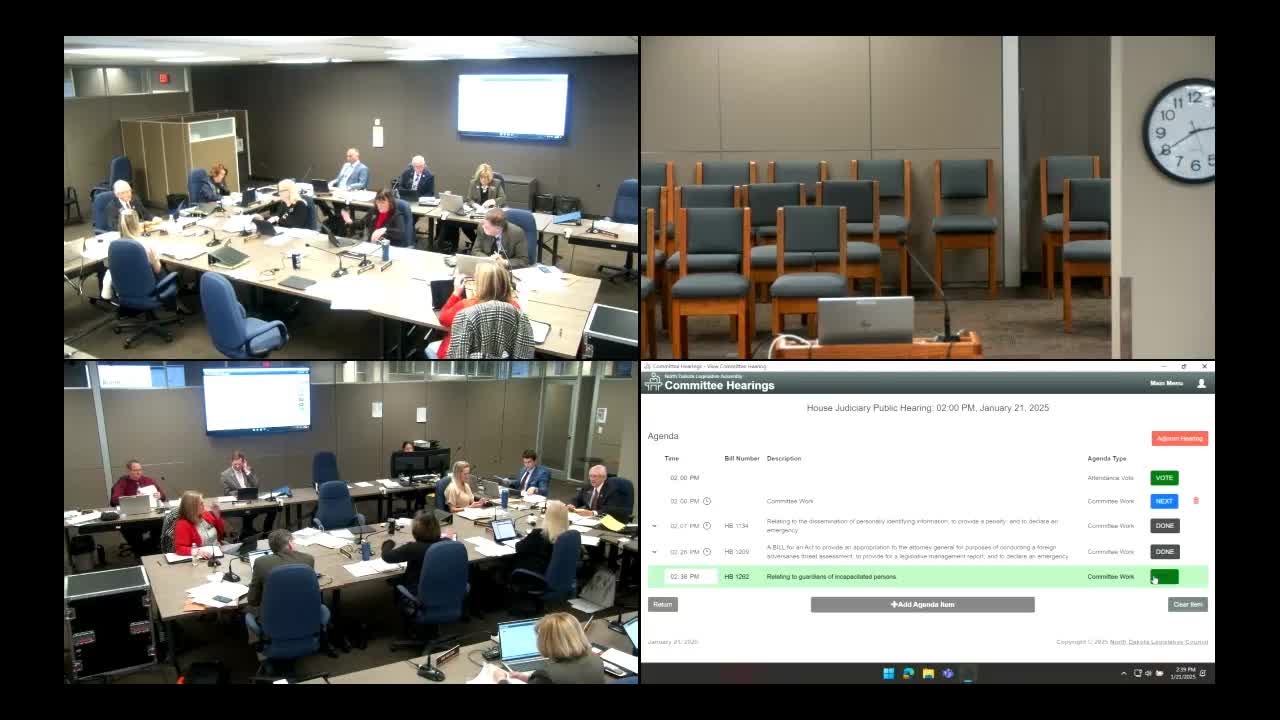
The committee voted to recommend 'do not pass' on House Bill 1262 after members said existing civil-commitment and guardianship procedures, along with vulnerable-adult services and public guardians, provide remedies for the case described at the bill hearing.
The House Judiciary Committee voted to recommend 'do not pass' on House Bill 1262 following committee discussion that existing civil-commitment and guardianship statutes — as well as vulnerable-adult services — offer remedies for the individual case described at the hearing.
Chairman Clamine and several members described the factual background from public testimony: an individual charged with terrorizing was found not fit to proceed and, as a result, could not be criminally prosecuted. Chairman Clamine explained that when a person is determined not fit to proceed "they can't be prosecuted," and that civil-commitment is the statutory path to get treatment if the individual is a danger to self or others.
Representative Wolff moved a 'do not pass' recommendation; Representative Olson seconded. Committee members and witnesses discussed alternatives: filing a civil-commitment petition, petitioning for the appointment of a guardian (including a public guardian if no private guardian is willing), and engaging vulnerable-adult services to seek remedial action. Representative Schneider summarized options: "There are 2 clear remedies... The petition for civil commitment and the petition for a guardian..."
Why it matters: the bill was presented in response to a specific case in which committee members said the system "kinda let him down." Members emphasized constitutional limits on forced prosecution when a person is found not fit to proceed, and the committee focused discussion on whether existing civil and guardianship channels could address the problem.
Committee action: the 'do not pass' motion carried 11-1 with three members absent. Representative Van Winkle agreed to serve as bill carrier for administrative follow-up. Committee members urged those involved in the case to pursue civil-commitment petitions or guardianship petitions and to contact vulnerable-adult services for assistance; the committee did not adopt statutory changes in this session on the matter.
Clarifying details recorded in committee included that guardianship orders may cover residential, medical, educational, vocational and financial decision-making; public guardianship is available where no private guardian will serve; and civil-commitment proceedings include deadlines for periodic review. No new statutory citations were added in this hearing, and the committee did not adopt the bill.