Get Full Government Meeting Transcripts, Videos, & Alerts Forever!
Get email alerts on the Correctional Healthcare Medicaid Reentry topic
No spam. Unsubscribe anytime.
Committee opens hearing on correctional healthcare standards; explores Medicaid pre-release and county cost burdens
Summary
Senate Bill 2191, which would provide guidance on correctional facility medical assessment and billing and explore pre-release Medicaid enrollment, was discussed in committee but was not voted on.
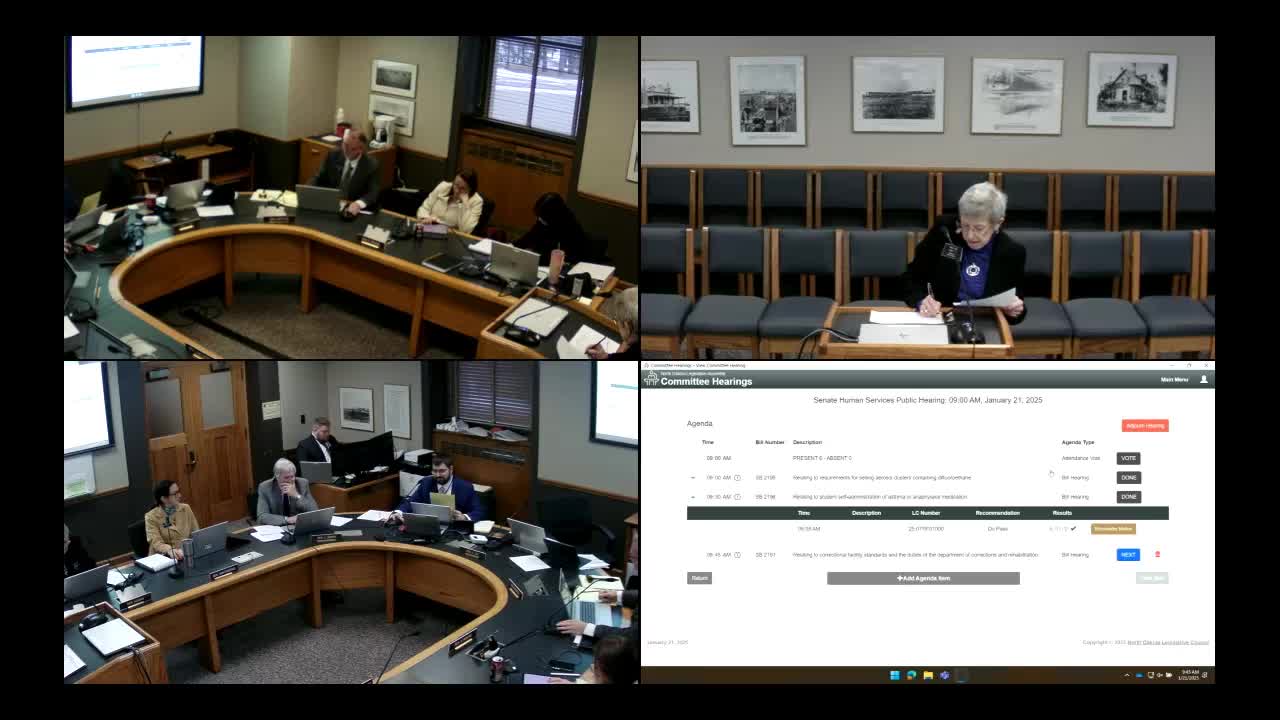
Senate Bill 2191, introduced by Senator Judy Lee, opened before the Senate Human Services Committee for discussion but did not receive a committee vote.
Lee said the bill grew from conversations with a reentry group and a Richland County judge who raised concerns about inconsistent health care and billing practices across county jails and prisons. "The base is what is Rolette County because it's the poorest county in the state," Lee said, arguing that differences in local tax bases and the presence of tribal lands can leave some counties unable to cover high medical costs for incarcerated people.
Lee described the bill's core aims as providing instruction to public and private correctional facilities on correct assessment and billing for medical care provided to inmates and exploring whether the state should supplement counties that face large medical bills. She also raised the federal policy change that permits states to enroll people in Medicaid up to three months before release so that Medicaid coverage is in place immediately upon reentry.
Committee members discussed practical and jurisdictional issues: counties are typically responsible for health care costs for people held in county jails, and practices and funding capacity vary widely across counties. Senator Hogan said the issue is complex and may require a more in-depth study; members agreed to involve the Association of Counties, sheriffs and corrections staff in further discussions.
No formal motions or votes were recorded on SB 2191 during the reported hearing. Senator Lee said she expects further work, possible amendments and engagement with relevant agencies and county officials before the bill is returned for later committee action.
Context and outstanding questions
Committee members flagged several points that will require clarification or further drafting: whether the proposed instruction should apply only to county jails or also to state prisons and private facilities; how to define a "base level" of medical care; what state role, if any, should be in supplementing county expenditures; and agency capacity for implementing pre-release Medicaid enrollment assistance. The Association of Counties had been notified to follow the discussion and may participate in subsequent hearings.