Get Full Government Meeting Transcripts, Videos, & Alerts Forever!
Get email alerts on the School Compliance Audits topic
No spam. Unsubscribe anytime.
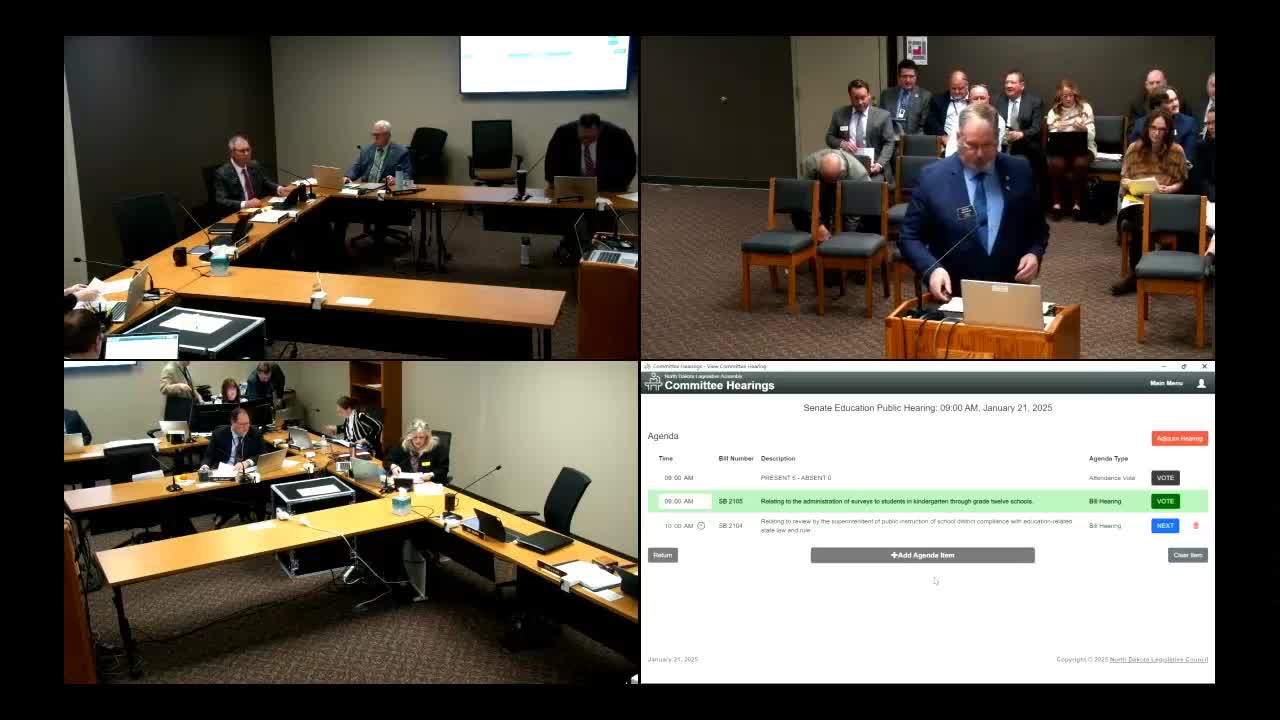
Bill to let state superintendent audit school compliance draws sharply divided testimony
Summary
Senate Bill 2104 would empower the state superintendent to review districts for statutory compliance, issue guidance and, after repeated findings, deduct 2 percent of a district’s state payments; the Education Committee heard divided testimony and took no vote.
Senate Bill 2104, sponsored by Senator Todd Beard, would require the state superintendent of public instruction to provide guidance to school districts on compliance with state law, conduct reviews when complaints are filed, and, if the department issues guidance more than once for the same matter, withhold 2 percent of a district’s state payments for that school year. The Senate Education Committee took testimony and closed the hearing without a committee vote.
Beard said the bill’s purpose is to “provide guidance and accountability for public schools to follow North Dakota statute and rules” and argued that government entities should face consequences if they fail to follow laws passed by the Legislature. The bill prescribes a complaint‑driven procedure: a review may be triggered by a citizen complaint, a majority request of a local board, or a request by a district superintendent or county; DPI must notify the district, investigate, and respond between 10 and 90 days. If DPI issues guidance more than once for a district on the same issue, subsection 3 would instruct DPI to deduct 2 percent of the district’s state payments for that school year.
Supporters told the committee the state needs stronger enforcement tools. Kimberly Hurst, who said she removed her children from public schools and now homeschools, cited increasing homeschooling numbers and said the state lacks an effective complaint process. Mark Jorritsma of North Dakota Family Alliance and Linda Thorson of Concerned Women for America urged the committee to pass the bill to ensure laws become enforceable.
Opponents said the bill would impose disproportionate penalties, overwhelm DPI and undermine local control. Michael Heilman of North Dakota Small Organized Schools said the procedure could inundate DPI with complaints and that a 2 percent cut “could have devastating consequences for districts,” cautioning that a loss of state aid at that scale could force staff reductions. Dr. Jeff Fosnott, superintendent of Bismarck Public Schools, said a 2 percent penalty for his district would represent roughly $2.5 million and “equates to approximately 23 teaching positions,” and questioned whether DPI has authority or capacity to carry out investigations and personnel enforcement under the proposal.
Several education groups, including the North Dakota Council of Educational Leaders, the North Dakota School Boards Association and NDCL, testified in opposition or expressed serious concerns, saying the bill shifts investigatory authority to an agency not structured for policing and risks eroding the cooperative relationship between DPI and districts. Superintendent Kirsten Basler offered a neutral critique, saying the bill “would significantly broaden the department’s regulatory power” and recommending that investigation authority remain with prosecuting offices (county state's attorneys or the Attorney General) or another entity better equipped to conduct legal investigations.
What’s next: The committee closed the hearing without voting; sponsors and opponents signaled a likely need for amendment if the measure is to move forward.